
How it works, step by step
- AssessAn engineer inspects the glass, identifies the contaminant and tests the cleaning water against your module maker's limits.
- PilotTest strings are cleaned beside untouched control strings and read in the same irradiance window. Free for utility-scale and large C&I plants.
- MethodThe method, interval, product and dilution for each task, written as a method statement your crews can follow.
- Equipment and waterBrushes, machines, dosing and water treatment matched to your modules and the chemistry. We can supply dosing pumps and other equipment.
- TrainingCrew training on site in dilution, application, brushing, rinsing and dosing, within the module maker's conditions.
- Supply and checkJust the Chemitek products to your crews, and a check of the results with string data or soiling sensors.
Who does the cleaning?
On most utility-scale and C&I plants, the plant’s own crews or its O&M contractor clean the modules. We make that cleaning work: we assess the soiling and the water, prove the method in a pilot, design the method and equipment, train the crews and supply the Chemitek products. Your contractor keeps the contract and the crews, and every service is optional.

| Site | What RenewChem does | Who runs the cleaning |
|---|---|---|
| Utility-scale plants | Assessment, free pilot, method, equipment, crew training, products | Your O&M contractor or in-house crews |
| C&I rooftops and carports | The same set-up, plus drone cleaning where access is unsafe | Your contractor or crews; RenewChem for drone work |
| Wind turbines | Blade, tower and nacelle cleaning by drone | RenewChem, under the wind farm’s safety procedure |
| Product only | Just the Chemitek products, with datasheets and dilution advice | Your crews |
As the official Southern African distributor of Chemitek, you can buy just the products from us, with or without our engineers. See the Chemitek range.
Cleaning methods and when each fits
| Method | Fits | Watch |
|---|---|---|
| Manual brush or water-fed pole | C&I rooftops and carports, small arrays, spot cleaning, removal agents on bonded soiling | Slow on large sites; hard water spots the glass unless treated |
| Rotary brush, handheld or tractor-mounted | Mid-size and utility-scale sites; tractor rigs need access roads and row spacing | Check rotating-brush rules in warranty-safe methods |
| Robot | Long, uniform rows cleaned often, and water-scarce sites | Many need designing into the plant (NREL 2018); module makers set rules on brush material and weight |
| Water-free (dry) cleaning | Loose dust in dry climates, between wet washes | Won’t break cemented dust, scale or lichen; some module makers restrict it |
| Drone | Roofs, façades, carports and arrays with no safe access | Sprays without brushing, so bonded soiling needs a restore step first |
Wet cleaning is generally preferred for its cleaning efficiency and lower risk of damage, and dry cleaning is used mostly where water is scarce (Ilse et al. 2019). Dry can be enough for loose dust: see soiling losses in South Africa. The two can be combined. A 115 MWc tracker plant in Chile alternated one wet clean with two dry cleans by tractor brush, four to six times a year (Santiago Solar case). Check the manual first: First Solar allows dry cleaning of its anti-reflective-coated modules only with soft cloths or mops, up to six times a year.
Equipment selection compares the machines in detail, drone cleaning covers hard-to-reach surfaces and low-water cleaning covers water-scarce sites.
What to clean with
Water alone removes loose dust. Bonded soiling needs a product made for it, and a product that leaves a protective layer keeps the glass cleaner between washes.
| Job | Chemitek product |
|---|---|
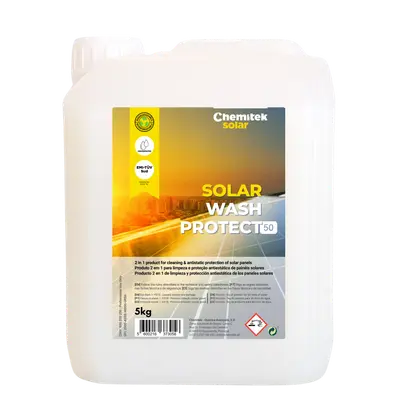
| Routine cleaning of dust, pollen, bird droppings and grease | Solar Wash Protect, which cleans and leaves an antistatic, anti-adherent layer |
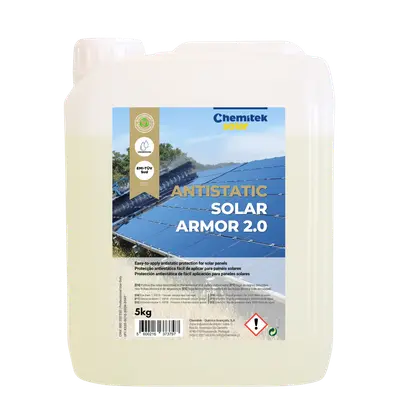
| Keeping glass cleaner between machine washes | Antistatic Solar Armor 2.0 or D-Solar Defendor, dosed into robot, tractor or rotary-brush water |
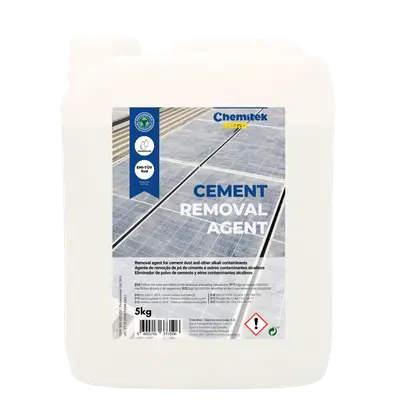
| Cured cement, stone dust, gypsum and hard-water stains | Inorganic Removal Agent (CRA) |
| Lichen, moss and fungi | Lichen Removal Agent |
| Rust and metal oxides | Metal Oxides Removal Agent: see rust stains |
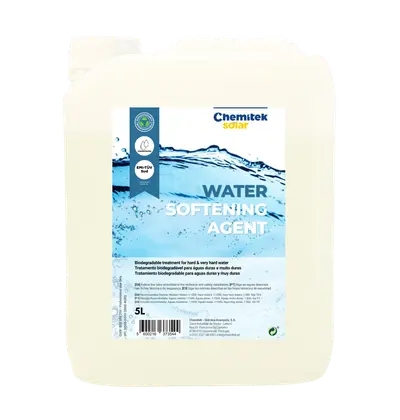
| Hard cleaning water | Water Softening Agent |
| Cleaning by drone | Drone Solar Cleaning Agent: see drone cleaning |
In a nine-month, peer-reviewed field trial at the Green Energy Park in Morocco, coated systems gained about 3% cumulative energy over a water-cleaned reference (case study). At a utility plant in Honduras cleaned with manual brushes, a string cleaned with Solar Wash Protect produced 1.8% and 2.9% more than two water-only strings over one month (case study). Chemitek reports up to 5% more energy than water-only cleaning, and up to 50% less water. Which product pays on your plant depends on the soiling: Chemitek products explained matches each product to its contaminant.
Water, warranty and frequency
Water: what the rinse leaves behind
Minerals in the cleaning water deposit on the glass and build up over time (LONGi 2024). Module makers’ hardness, TDS and pH limits differ widely: see cleaning-water testing. Hard-water washing can leave a string worse than before, as the Malaysia case shows. We test the water on site and set the treatment: see hard-water stains.
Keeping it warranty-safe
Module makers set cleaning conditions, and damage from cleaning outside them can void the warranty: Trina’s manual says so in as many words. A letter of conformity covers the product used within the maker’s conditions; the tools and method still have to meet the manual. JA Solar’s 2025 letter for ten Chemitek products, for example, excludes damage caused by cleaning tools. Pressure, brush and temperature limits are in warranty-safe methods. See also cleaning and your module warranty.
How often to clean
LONGi’s manual sets a default of at least one clean every 20–30 days in dry areas and every 40–50 days in rainy ones. The right interval depends on your tariff, soiling rate and what a clean costs, and it changes with the season. The calculator works it out for your plant. See also the cleaning frequency guide and our cleaning strategy service.
Proof before you commit
On utility-scale and large C&I plants, a free pilot tests the method on your own strings, cleaned beside untouched control strings and read in the same irradiance window.
What it shows depends on what is on the glass. Soiling, the dust, sand and pollen that build up between cleans, is on almost every plant. Solar Wash Protect or Antistatic Solar Armor 2.0 in the normal clean handles it, and usually adds a few percent over water-only cleaning. Contamination, such as cement, limescale, metal oxides or lichen, bonds to the glass and keeps building until it is removed. It needs a removal agent first, then a coating so it doesn’t bond again, and these plants usually gain the most. Published cases show both:
| Case | Method | Result |
|---|---|---|
| Morocco, Green Energy Park (peer-reviewed) | Manual cleaning; three Chemitek products against water | About 3% cumulative energy gain over nine months |
| Honduras, utility plant | Manual brushes, Solar Wash Protect | 1.8% and 2.9% more than two water-only strings in one month |
| Vietnam, 330 MW | Robot, D-Solar Defendor in the water | Coated strings produced more than water-cleaned strings, in the dry season and the rainy season |
| India, rooftop | Manual brushes, Solar Wash Protect | On average 5.1% more energy a day than a water-cleaned string, over 16 days |
| Malaysia, 850 kWp | Well water against Solar Wash Protect | The hard-water wash left a string worse off; Solar Wash Protect in the same water gained |
| Dubai, cement dust | One Inorganic Removal Agent clean | Closed most of the gap to a clean reference inverter |
| Chile, cement-dusted carport | Inorganic Removal Agent, then Antistatic Solar Armor | Restored and coated modules pulled well ahead of water-cleaned ones |
Chemitek products for this
- Clean + protectSolar Wash ProtectConcentrated PV cleaner that leaves an antistatic, anti-adherent layer. 18 module-maker letters of conformity.
- ProtectAntistatic Solar Armor 2.0Anti-soiling coatings dosed into the wash water at 1 kg to 1,000 L. At least 12 months of protection (Chemitek).
- RestoreInorganic Removal AgentDissolves cured cement dust, stone dust and gypsum that water can’t shift. 8 module-maker letters of conformity.
- PreventWater Softening AgentSoftens hard cleaning water in about 20 minutes, so rinses don’t leave scale.
Running your own crews? You can order just these products from us, with or without our engineers.


