
Contamination or erosion?
South Africa’s wind fleet. South Africa had 3,807 MW of wind under REIPPPP at 30 June 2025 (CSIR 2025), and IRP 2025 plans another 7,341 MW of wind for 2026–2030 (DMRE). That is a great deal of blade surface to keep clean.
We found no published data on blade soiling or erosion at South African wind farms. So we don’t quote you a loss from somewhere else. We inspect your blades and compare each turbine’s power curve before and after cleaning.
Cleaning fixes contamination, not erosion. Before we plan a clean, we check which one each blade has.
| What | Contamination | Leading-edge erosion |
|---|---|---|
| What it is | Insects, dust, oil, soot or bird droppings stuck to the blade | Blade material worn away: pitting, gouges, exposed laminate |
| What it costs | Up to 25% of production from insects on older stall-regulated turbines (Corten & Veldkamp 2001); modelled at 4.9–6.8% of annual energy for 200 µm of insect roughness (Wilcox & White 2016) | 0.9%, 1.6% or 2.6% of annual energy by damage category at a 6 m/s site (IEA Wind Task 46, 2023) |
| The fix | Cleaning | Repair and leading-edge protection by a blade-repair specialist |
| Proof it paid | Power curves before and after the clean | Measured annual energy rose 1.5–2% after moderate erosion was repaired (ORE Catapult BLEEP, 2016) |
Modern pitch-regulated turbines lose less to insects than the stall-regulated turbines in the 2001 study, so treat 25% as an upper bound, not a forecast. If our inspection finds erosion, we say so and pass the photos to your blade-repair team.
How a drone blade clean works
Select a step to jump to it. The dwell is shortened in the animation; the method needs five minutes.
- Inspect and read the data. Photograph the blades, tower and nacelle, and pull power curves from SCADA.
- Plan with the site. Agree the turbine sequence with the wind farm and the turbine maker’s service team, and fit the work into planned stops.
- Stop and secure the turbine. The wind farm’s own lock-out and permit procedure comes before anyone, or any drone, works on it.
- Mix to the contamination: 1:10 for heavy, 1:20 for medium and 1:30 for light, in ordinary water (Chemitek).
- Spray as a foam. At least 0.1–0.2 L of diluted product per m². A green marker pigment shows the operator where it has landed on a white blade.
- Wait five minutes, then rinse. A high-pressure water jet takes the foam and the dirt off.
- Check the result. Photograph the blades, and compare power curves before and after.
The same agent lifts oil, grease and soot from towers and nacelles, which also makes new leaks easier to spot. The blade cleaning service sets out the full method, and the product page has Chemitek’s figures.
Working with the turbine maker
Where blades are maintained under the turbine maker’s service agreement, cleaning has to fit that agreement, not work around it. We:
- check the turbine maker’s blade maintenance requirements and coating specification before the first turbine;
- share the method statement and safety data sheets with the service team;
- schedule cleaning into planned stops, to limit extra downtime;
- report erosion, cracks or other damage we see, with photos, to the service team.
Chemitek lists the agent as suitable for lacquered, coated and painted surfaces, epoxy resins, plastics, rubbers and metals. It is water-based, non-flammable, solvent-free and readily biodegradable (Chemitek). Where the service agreement calls for the turbine maker’s approval, we get it in writing first.
Safety procedures and approvals
The wind farm’s safety system governs the work: induction, permits, lock-out, exclusion zones under the rotor and weather limits. Our method statement slots into it, and the rinse water that falls below the turbine is checked against your environmental authorisation.
For any contractor you appoint, these are the neutral requirements:
- Drones: under SACAA Part 101, the operator needs an Air Service Licence, an operator certificate (ROC, also called a UASOC) and an RPAS Letter of Approval. Each pilot needs a Remote Pilot Licence, and the aircraft must be registered.
- Work on the turbine: GWO Basic Safety Training is effectively a contract requirement.
- Rope access: technicians typically hold IRATA certification.
Ask for copies before work starts. See drone cleaning for how we plan drone work.
What you get
- An inspection record that separates contamination from erosion, with photos.
- A method statement fitted to your wind farm’s procedures and the turbine maker’s requirements.
- The clean itself, by drone, or the product with dilution guidance and safety data sheets for your own team.
- A before-and-after power-curve comparison for every turbine cleaned.
If you run the wind farm’s O&M, we work alongside your team rather than replace it.
Chemitek products for this
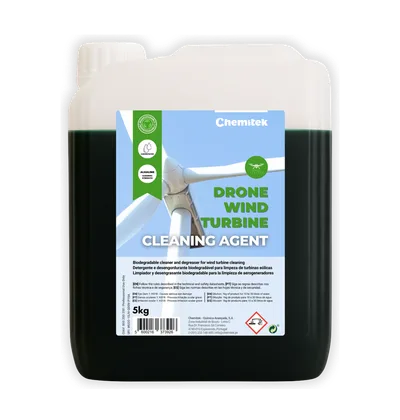
Running your own crews? You can order just these products from us, with or without our engineers.


