
Why is cleaning water a problem in South Africa?
South Africa gets about 490 mm of rain a year, about half the world average, and demand for water is expected to grow 32% by 2030 (WWF-SA). The national water master plan projects a shortfall equal to 17% of supply by 2030 (DWS). Parts of the Northern Cape, home to much of the country’s utility-scale PV and all of its CSP, get under 70 mm a year (SAEON). So plants truck water in, pump boreholes or wait for rain.
More water isn’t always the answer anyway. Hard borehole water leaves scale as it dries, and no amount of water shifts dust that dew has cemented to the glass.
What does cleaning water cost?
| Item | Figure | Source |
|---|---|---|
| Wet clean, per m² of module | ~1 L/m² (US literature); ~3 L/m² (SA dissertation) | NREL (2018); Naicker (2018) |
| Module area of a 10 MWp plant | ~48,000–55,000 m² | Calculation from Ilse et al. (2019) |
| One full wet wash, 10 MWp | ~50–150 m³ | Calculation from the rows above |
| Operational water use, utility PV (median) | ~0.10 m³/MWh | Macknick et al. (2011) |
Skipping washes costs energy instead. The job is to spend each cubic metre where it buys back the most energy: try the soiling loss calculator.
How we diagnose it
- Soiling rate. Reference panels, soiling stations or optical sensors show how fast you lose output, and so how often a wash pays. See soiling measurement.
- Contaminant. Loose dust can come off dry; cemented dust, droppings and scale can’t.
- Water. Source, hardness, cost per cubic metre and haul distance. See water-quality testing.
- Current practice. Litres per m² today, equipment, crew speed and when you clean.
- Module rules. Some approvals specify wet cleaning: LONGi’s letter of conformity for Chemitek products lists it among its conditions.
How we cut the water
In water-scarce regions we usually recommend a hybrid: dry cleaning for routine loose dust, and fewer, better-timed wet washes for what dry brushing can’t lift.
| Method | Water | Works on | Watch out for |
|---|---|---|---|
| Dry brushing or waterless robot | None | Loose dust | Cemented dust, droppings and scale; approvals that require wet cleaning; brushes can wear coatings (IEA PVPS 2022) |
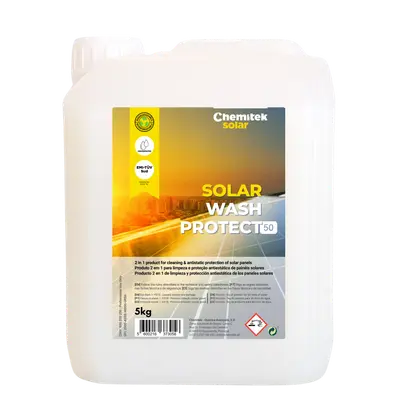
| Wet wash with Solar Wash Protect | Up to 50% less than water-only (Chemitek’s claim) | Most soiling, by manual, rotary, robot or tractor brush | The rinse is essential; we measure the real saving |
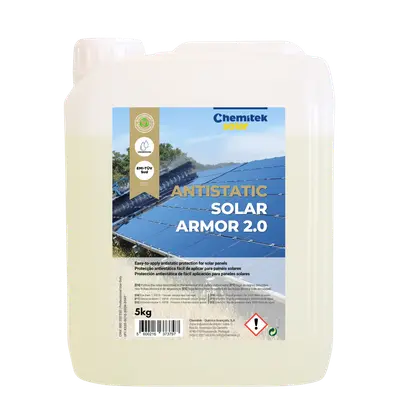
| Coating dosed into the wash (ASA 2.0, D-Solar Defendor) | About 50% less (Chemitek’s claim); see the Vietnam case for a robot-cleaned plant | Robots, tractor and rotary brushes | Site-specific: a hydrophobic coating increased soiling in a Northern Cape trial |
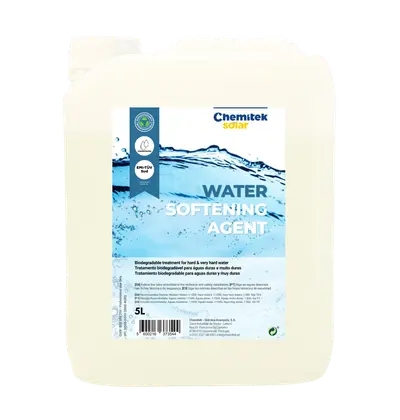
| Softened wash water (Water Softening Agent) | Same volume, no scale | Hard borehole or municipal water | Dose to the measured hardness |
The products, from Chemitek’s datasheets: Solar Wash Protect (SWP 50 at 1 kg to 50 L, or SWP 300 at 1 kg to 300 L; about 150–200 mL/m²; readily biodegradable). Antistatic Solar Armor 2.0 (1 kg to 1,000 L; at least 12 months of protection, per Chemitek). D-Solar Defendor (1 kg to 1,000 L of soft water). See Solar Wash Protect · See anti-soiling coatings.
About “up to 50%”. It is a vendor claim, and it compares with traditional manual cleaning. With tractor brushes and robots the saving is smaller, because the chemistry mainly lets the machine clean faster. We quote your saving only once we have measured it.
How to keep panels clean for longer.
- Stretch the interval with a coating, once a pilot shows it works on your site.
- Let the rain work. Plan washes around the rain, not just before it. See the Kalkbult rain findings.
- Fewer, better-timed washes. The right interval depends on your tariff, soiling rate and what a clean costs, and it changes with the season. The calculator works it out for your plant. Expensive water means fewer washes, each timed to pay back more. See cleaning strategy.
The evidence
Case study: Chemitek (Portugal), with Green Energy Park, Morocco. In a nine-month peer-reviewed trial in semi-arid Benguerir (Heliyon, 2023, co-authored by Green Energy Park and Chemitek staff), Solar Wash Protect needed 50% less water. See the Morocco trial.

Case study: Chemitek (Portugal), with BIM AC Renewables, Vietnam. Over a year on a 330 MW plant cleaned by robot, D-Solar Defendor cut cleaning water. See the Vietnam case.

Case study: Chemitek (Portugal), with EDF Energies Nouvelles and Marubeni, Chile. On the 115 MWc Santiago Solar tracker plant, tractor brushes ran faster on D-Solar Defendor-coated modules. With a continuous water flow, faster passes use less water per m². See the Santiago case.
The counter-example. In a Northern Cape trial, a hydrophobic coating increased soiling, opening a performance-ratio gap of up to 5.5% (du Plessis et al. 2020). That result is why we prove a coating on your own strings before recommending it for the whole plant.
Short of water? Utility-scale and large C&I plants qualify for a free pilot, where we measure water use as well as output.
Chemitek products for this
- Clean + protectSolar Wash ProtectConcentrated PV cleaner that leaves an antistatic, anti-adherent layer. 18 module-maker letters of conformity.
- ProtectAntistatic Solar Armor 2.0Anti-soiling coatings dosed into the wash water at 1 kg to 1,000 L. At least 12 months of protection (Chemitek).
- PreventWater Softening AgentSoftens hard cleaning water in about 20 minutes, so rinses don’t leave scale.
Running your own crews? You can order just these products from us, with or without our engineers.


