
Letters of conformity
A letter of conformity is a module maker’s written confirmation that a cleaning product may be used on its modules. Chemitek counts them per product.
- Solar Wash Protect18
- Antistatic Solar Armor 2.017
- Inorganic Removal Agent8
- Lichen Removal Agent4
- D-Solar Defendor3
- Water Softening Agent3
- Metal Oxides Removal Agent3
Solar Wash Protect: the 18 makers
- Aiko
- Astronergy
- Canadian Solar
- CSun
- EVVO
- First Solar
- GCL
- JA Solar
- Jinko
- LONGi
- ReneSola
- Risen
- Runergy
- Seraphim
- Suntech
- Trina
- Ureco
- Znshine
Inorganic Removal Agent: the 8 makers
- Canadian Solar
- JA Solar
- Jinko
- LONGi
- Risen
- Runergy
- Suntech
- Trina
Counts from Chemitek. The makers for the other products are listed on request.
A letter is not a blanket warranty guarantee. LONGi’s sample letter says so, and lists conditions: wet cleaning only, a water-pressure limit, the brush type and trained staff. Letters can also be limited to named module series, or be preliminary pending further testing. So the accurate wording is: approved by the module maker when used within its cleaning conditions. We give you the letter for your module maker and check that it covers your modules. Read more in cleaning and your module warranty or in the letters of conformity on our products page.
Makers’ conditions
What module makers’ letters and manuals set, with examples. Equipment selection covers the tools that stay inside these limits.
| Condition | Examples |
|---|---|
| Cleaning method | Wet cleaning only (LONGi’s sample letter) |
| Water pressure | ≤0.7 MPa on the module (LONGi); 35 bar at the nozzle (First Solar); 4 MPa, or 40 bar (Canadian Solar, Trina); no pressure washers at all (Yingli) |
| Brushes | Brush type set in LONGi’s letter; Canadian Solar cautions against rotating brushes, which can cause micro-cracks |
| Water quality | Hardness, TDS and pH — see water testing |
| Water temperature | Within −5/+10 °C of the module (Trina); no more than 10 °C apart (LONGi, Jinko); no more than 20 °C apart (First Solar) |
| Staff | Trained staff (LONGi’s sample letter) |
Coatings and frames
Module glass carries an anti-reflective (AR) coating. Abrasive methods damage it, and scrubbing a cured film without the right chemistry is where coatings get scratched. Chemitek’s removal agents react with the contaminant, not the glass: Inorganic Removal Agent and Lichen Removal Agent are designed to be gentle on the AR coating, the silicone and the aluminium frame. Chemitek builds aluminium-frame protection into its formulations, which is what lets removal agents such as Inorganic Removal Agent use actives that aren’t pH-neutral. Its PV products were tested by ÉMI-TÜV SÜD for safety on module glass, AR coatings and frames.
Chemitek’s cement case studies show the same judgement on working plants. On a 48 kWp carport in Chile and a 160 kWp plant in Israel, water had failed to shift cured cement, and scrapers and high-pressure washing were ruled out because they would damage the modules and void the warranty. Both used Inorganic Removal Agent instead (Case study: Chemitek (Portugal), with Ecomundo; Case study: Chemitek (Portugal), with Girasol). See the Chile case and the Israel case.
Anti-soiling coatings need care too. Brushes can wear them (IEA PVPS 2022), so brush type and pressure still matter after the Protect step.
Other risks to the asset
Dirt is an asset risk too. Soiling costs more than yield. Bird droppings and edge dust can create hot spots that switch on bypass diodes: see bird droppings. Left too long, lichens, fungi and cemented dust can become practically irremovable (Ilse et al. 2019). Timely, safe cleaning protects the modules as well as the output.
Environmental conditions. Chemitek describes Solar Wash Protect as readily biodegradable, and has biodegradability tested to OECD 301F by Portugal’s Centre for Waste Valorisation (CVR). That matters where an environmental authorisation limits run-off: one North West project’s environmental management programme allows cleaning only with clean water or biodegradable, non-hazardous products (Boshoek Solar EMPr, 2024).
Our six checks
- Identify the module make and model, and find its current cleaning conditions.
- Get the product’s letter of conformity for that maker, and check that it covers your modules.
- Test the cleaning water against the maker’s limits.
- Set the method, pressure and brush type within those conditions.
- Train the crew, since trained staff are a condition too. We work alongside your O&M team.
- Record the dilution, water test, pressure, crew and date for every clean, so there is a paper trail if a warranty question ever comes up.
Chemitek products for this
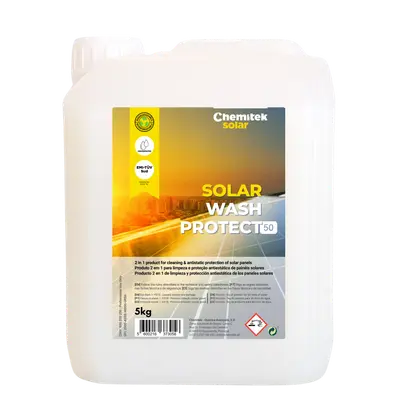
- Clean + protectSolar Wash ProtectConcentrated PV cleaner that leaves an antistatic, anti-adherent layer. 18 module-maker letters of conformity.
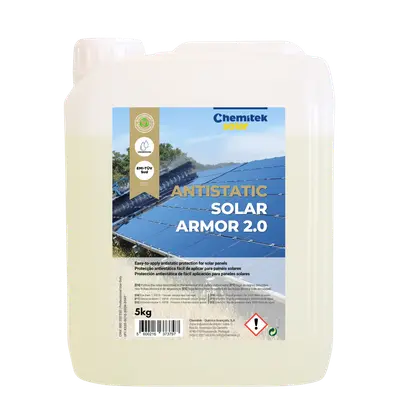
- ProtectAntistatic Solar Armor 2.0Anti-soiling coatings dosed into the wash water at 1 kg to 1,000 L. At least 12 months of protection (Chemitek).
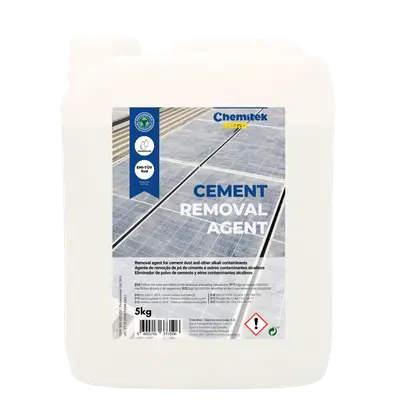
- RestoreInorganic Removal AgentDissolves cured cement dust, stone dust and gypsum that water can’t shift. 8 module-maker letters of conformity.
Running your own crews? You can order just these products from us, with or without our engineers.


