
Why does washing leave panels dirtier?
Hard water carries dissolved calcium and magnesium. When a rinse dries on warm glass, the water evaporates and the minerals stay behind as white spots, rings and a thin haze. Wash again with the same water and the layer builds. Rinsing harder only lays down more minerals, and the same scale clogs brushes, hoses and dosing equipment.

Borehole and municipal water can both be hard, and hardness varies between sources and over time. You can’t see it in the tank; only a test tells you.
The stains also hide in plain sight. After a wash, the array looks clean from the road while the haze keeps cutting the light that reaches the cells.
What does hard water cost?
The clearest measurement comes from Chemitek’s case with TNBES on an 850 kWp hybrid plant in Malaysia. Over 20 days in 2020, one string washed only with high-TDS well water produced 4.9% less than its own average: the panels came out dirtier than before. A second string, washed with Solar Wash Protect diluted in the same water, gained 3.84%, or 2.78% net of the irradiance rise shown by an uncleaned reference string.
Module makers set cleaning-water limits for exactly this reason, and washing outside them puts you outside the maker’s cleaning conditions. The limits and the basis they use differ by maker: see water quality for solar panel cleaning.
For scale, the USGS classes water above 180 mg/L as CaCO₃ as very hard. Water can sit inside one maker’s limit and far outside another’s, so the module on your roof or field decides.
How we diagnose it
- Test every water source on site. Borehole, municipal, trucked and treated water can all differ. We measure hardness with test strips and check the other values your module maker limits. See water-quality testing.
- Don’t rely on a TDS meter. TDS counts every dissolved solid, not just calcium and magnesium, and once Water Softening Agent is in the water a TDS meter reads the product, not the hardness.
- Inspect the glass. Scale shows as spots and rings where droplets dried, often heaviest along the bottom edge. Cement films and baked-on dust look different and need a different fix.
- Measure the effect. Where it matters, we compare washed strings with control strings in the same irradiance, as in the Malaysia case.
- Review the method. Time of day, rinse volume, water temperature, and whether the final rinse is squeegeed or left to dry.
How we fix it
Two jobs: stop new scale forming, and remove what is already there.
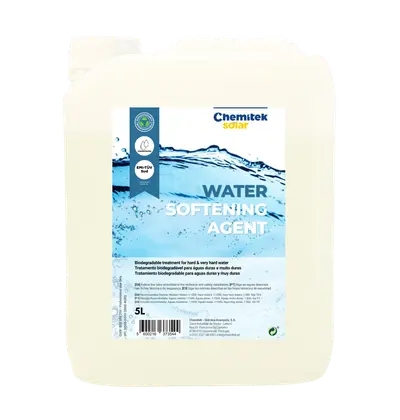
Soften the water with Chemitek Water Softening Agent (WSA). WSA captures the calcium and magnesium ions in the water itself, so nothing is left to deposit when the rinse dries. Add it to the tank, wait about 20 minutes, then measure again to confirm the water is soft. The dose follows the hardness: for direct tank dosing, Chemitek’s datasheet gives 1:500 at 250 ppm, 1:1,500 at 125 ppm and 1:5,000 at 25 ppm, with separate ratios for dosing pumps (for example 1:640 at 200 ppm). WSA works in tanks, dosing pumps, water-fed poles, rotary brushes and robots. It has been tested by ÉMI-TÜV SÜD and carries letters of conformity from 3 module makers. If you already know your hardness, order WSA and hardness test strips on their own and dose from the table. See Water Softening Agent.
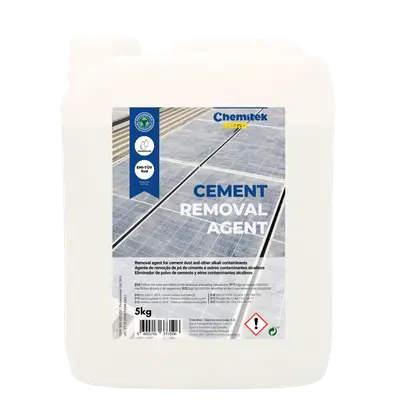
Remove existing scale with Chemitek Inorganic Removal Agent (CRA). CRA dissolves hard-water stains along with other alkaline deposits. We test a small area first, start at 1 kg of CRA to 2 L of water, apply it to dry glass and rinse with softened water. See Inorganic Removal Agent.
Or change the water. Reverse-osmosis or deionised water can also meet the limits. In a survey of 11 South African solar IPPs, all reported using reverse-osmosis water, from boreholes or municipal supply (Naicker 2018). We compare the cost of running RO with dosing WSA for your volumes.
How to stop it coming back
- Treat every wash. Dose WSA, or keep the RO plant running, on every clean, and re-test whenever the water source changes.
- Don’t let rinse water bake on. Clean in the cooler part of the day, keep the water close to module temperature and squeegee where practical.
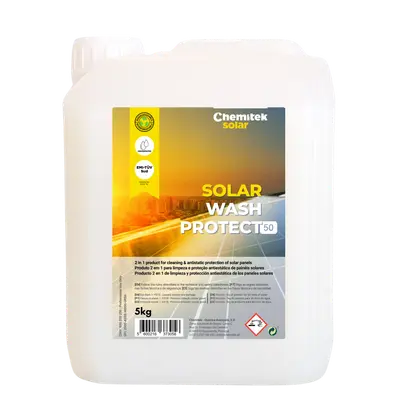
- Wash with softened water. Where the water is hard, we pair Solar Wash Protect with Water Softening Agent, so the clean leaves an anti-adherent layer instead of scale. D-Solar Defendor must always be mixed with soft water.
- Wash only as often as the soiling justifies. Every unnecessary wash with hard water is another chance to leave scale. We set the interval from measured soiling: see cleaning strategy.
The evidence

Case study: Chemitek (Portugal), with TNBES, Malaysia. Three strings of 285 panels each over 20 days (18 August–6 September 2020), with an uncleaned string as the irradiance reference. Well water only: −4.9%. Solar Wash Protect in the same water: +2.78% net. Same water, same period: the difference was what went into the wash. See the Malaysia case.
For the full picture on module-maker limits, read water quality for solar panel cleaning.
Not sure what’s in your water? Utility-scale and large C&I plants get an on-site water test as part of a free pilot.
Chemitek products for this
- PreventWater Softening AgentSoftens hard cleaning water in about 20 minutes, so rinses don’t leave scale.
- Clean + protectSolar Wash ProtectConcentrated PV cleaner that leaves an antistatic, anti-adherent layer. 18 module-maker letters of conformity.
- RestoreInorganic Removal AgentDissolves cured cement dust, stone dust and gypsum that water can’t shift. 8 module-maker letters of conformity.
Running your own crews? You can order just these products from us, with or without our engineers.


