
Why won’t water shift cement dust?
Cement, limestone and stone dust are alkaline. Once they land on the glass, dew, rain or the last rinse dissolves the soluble part, and it recrystallises into a bonded film. The IEA PVPS soiling report calls this cementation, and the bonds it forms can’t be broken by dry cleaning. Water and brushing only take off the loose layer on top.

The film builds fastest on rows downwind of cement works, quarries, precast yards and building sites, and along the bottom edge of each module, where rinse water collects and dries. It looks like ordinary dust until a wash leaves it in place.
Scrubbing harder makes it worse. Scrapers and abrasive pads remove the film by scratching the anti-reflective coating, and that loss is permanent. It can also void the module warranty.
What does cement dust cost?
More than a thin film suggests, because cement is contamination, not ordinary soiling.
The measured results:
| Site | What was compared | Result | Source |
|---|---|---|---|
| 288 panels, Dubai | Treated inverter vs a clean reference inverter, 1 May–5 June 2022; one CRA clean at 1:2 after fortnightly water and brush cleans had failed | Gap cut from −6.59% to −2.06% (five-day averages) | Chemitek case study, with SirajPower |
| 48 kWp carport beside a precast-concrete factory, Chile | 45 modules treated with CRA and ASA vs 45 cleaned the traditional way | Daily generation gap grew from 4.56% to about 11.9% by 8 November 2022 | Chemitek case study, with Ecomundo |
In a small outdoor study, real cement dust at 10.4 g/m² cut module efficiency by 3.2% on average (Kuppan & Natarajan 2019). To turn a loss into rands for your plant, use the soiling loss calculator.
How we diagnose it
- Inspect the glass. We photograph the film, map where it is heaviest and check what lies upwind.
- Confirm the contaminant. Cured cement, hard-water scale and baked-on dust look alike from a distance. The pattern, the water test and a small CRA test patch tell them apart and set the starting dilution.
- Test the water. Hard rinse water adds its own scale. See water-quality testing.
- Measure the loss. String current against comparable strings in the same irradiance window, reference panels or an optical soiling sensor. See soiling measurement.
- Check the rules. We read your module maker’s cleaning conditions before anything touches the glass.
How we remove it
Method first: brushes, water, crew and access. For cured cement that means a sprayer, brushes that can work without water and a clean rinse; see equipment selection. Then the chemistry.
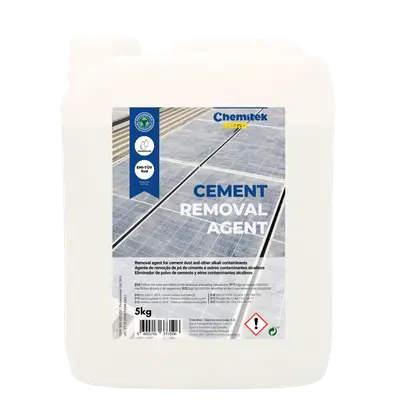
Chemitek Inorganic Removal Agent (CRA) reacts with cement, stone dust, gypsum and other alkaline deposits, not with the glass, and is designed to be gentle on the anti-reflective coating, silicone and aluminium frame. Chemitek’s datasheet method:
- Test a small area first to find the right dilution.
- Start at 1 kg of CRA to 2 L of water; strengthen to 1:1 or 1:0.5 if needed. Neat is a last resort.
- Apply to dry modules. Wet glass greatly reduces the effect.
- Let it react for a few seconds without drying, then brush it in without adding water.
- Rinse thoroughly with clean water and a brush. Repeat if needed.
CRA has been tested by ÉMI-TÜV SÜD and carries letters of conformity from 8 module makers, each valid within that maker’s cleaning conditions. Packs: 5 kg, 20 kg and 1,000 kg IBC. See Inorganic Removal Agent.
If your crews already know the film and only need the product, order just CRA and follow this method. Our engineers are a phone call away if a patch won’t lift.
How to stop it coming back
Removal is half the job. Clean glass next to a cement works starts collecting dust the same day.
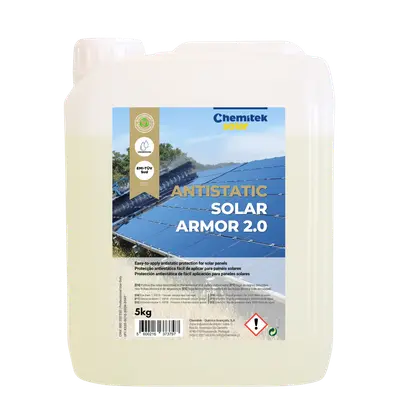
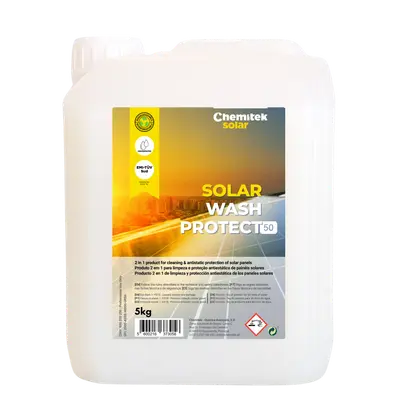
- Protect. Chemitek recommends Antistatic Solar Armor 2.0 straight after CRA. It is dosed at 1 kg to 1,000 L of cleaning water through rotary brushes, robots or tractor brushes, and must go onto fully clean glass. Chemitek reports at least 12 months of protection. For manual brushing, Solar Wash Protect is the better fit.
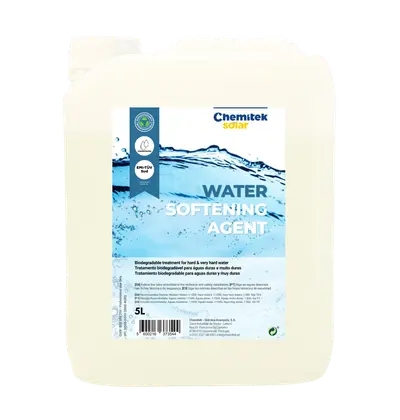
- Treat the water. Soften hard water with Water Softening Agent so each rinse doesn’t add scale.
- Maintain on a measured interval. The programme runs Restore (CRA) → Protect (ASA 2.0) → Maintain (Solar Wash Protect 50, with softened water where the supply is hard), on a calendar set from soiling data. See Restore → Protect → Maintain.
Coatings behave differently from site to site, so prove them on a few strings before a plant-wide roll-out.
Does a coating keep it off after removal?

Case study: Chemitek (Portugal), with Girasol, Israel. On a 160 kWp plant where cured cement had defeated water, the O&M team removed it with Inorganic Removal Agent, then coated 10 modules with Antistatic Solar Armor by cleaning robot. Two weeks later the coated modules still cleaned fully, while cement had stuck to the uncoated ones. The team decided to use CRA across the plant and to apply the coating regularly, so crews wouldn’t need CRA every time. See the Israel case.
Cement film on your plant? Utility-scale and large C&I plants qualify for a free pilot: treated strings against control strings, under the same sun.
Chemitek products for this
- RestoreInorganic Removal AgentDissolves cured cement dust, stone dust and gypsum that water can’t shift. 8 module-maker letters of conformity.
- ProtectAntistatic Solar Armor 2.0Anti-soiling coatings dosed into the wash water at 1 kg to 1,000 L. At least 12 months of protection (Chemitek).
- Clean + protectSolar Wash ProtectConcentrated PV cleaner that leaves an antistatic, anti-adherent layer. 18 module-maker letters of conformity.
- PreventWater Softening AgentSoftens hard cleaning water in about 20 minutes, so rinses don’t leave scale.
Running your own crews? You can order just these products from us, with or without our engineers.


