
Why farm solar soils faster
Field dust. Ploughing, harvesting and gravel farm roads put dust in the air for much of the year. NREL’s O&M guide puts heavily farmed land at about 0.36% of output lost a day, against about 0.05% in typical conditions. At that rate a farm array loses about 2.5% in a week, more than a typical site loses in a month (our arithmetic).

Birds. Dams, sheds, silos and power lines draw birds, and a dropping shades part of a cell completely. At a South African PV plant, one dropping made a cell 11.1 °C hotter and switched on its bypass diode (Vumbugwa et al. 2020), and NREL reports soiling of up to 0.5% a day near large bird populations. See bird droppings on solar panels.
Water. Farms often clean with borehole water, and hard water leaves scale on the glass every time a rinse dries. Test it before the first wash. See cleaning-water testing.
Growth. Shaded, damp corners of shed roofs can grow lichen and moss that water won’t shift. See lichen, moss and algae.
Which product for which job?
| What’s on the glass | Chemitek product | Chemitek’s method |
|---|---|---|
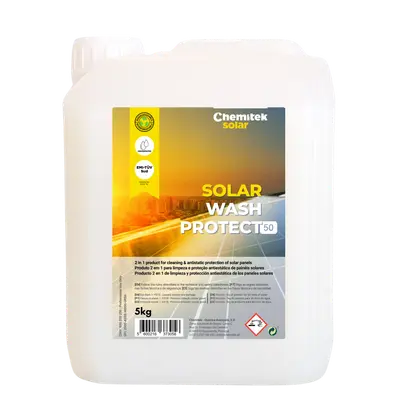
| Field dust, pollen, droppings | Solar Wash Protect (SWP 50) | 1 kg to 50 L of water, about 150–200 mL/m²; brush, then rinse |
| Hard-water scale | Inorganic Removal Agent | Start at 1 kg to 2 L on dry glass; brush in, then rinse |
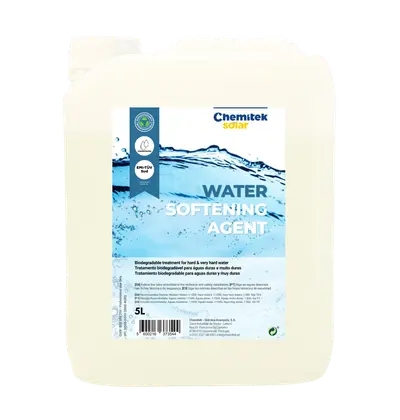
| Hard wash water | Water Softening Agent | Dosed into the tank to the measured hardness |
| Lichen and moss | Lichen Removal Agent | 1 kg to 10 L; soak 10–20 minutes, brush, rinse |
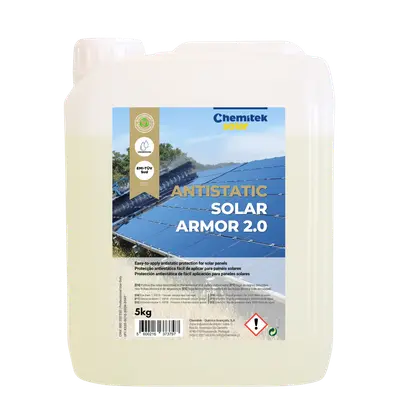
| Dust settling again after a clean | Antistatic Solar Armor 2.0 | 1 kg to 1,000 L through rotary brushes or robots, not by manual brush |
Chemitek’s PV products were tested by ÉMI-TÜV SÜD for safety on module glass, anti-reflective coatings and frames. Where water is scarce, see low-water cleaning.
Time the clean to the farm calendar
Dust peaks when the land is worked and in the dry months. Clean after the dustiest work is done, such as ploughing and harvest, and ahead of the months when your array carries the most load, rather than on a fixed date. If you’re not sure how fast your panels soil, a site soiling assessment measures it.
Get your panels cleaned
- A partner crew near you. Request a cleaning and we match you with a trained cleaning company from our partner network.
- Your own farm team. We set up the method, the chemistry and the cleaning-water checks, and give you the safety data sheets for your file.
- Shed roofs and hard access. Water-fed poles from a safe edge, or drone cleaning where a roof is fragile or steep.
- Large agricultural plants. Utility-scale and large C&I sites qualify for a free pilot: treated strings against untreated ones, under the same sun.
We work on farms across South Africa and into Southern and Central Africa, and supply Chemitek products throughout the region.
Chemitek products for this
- Clean + protectSolar Wash ProtectConcentrated PV cleaner that leaves an antistatic, anti-adherent layer. 18 module-maker letters of conformity.
- PreventWater Softening AgentSoftens hard cleaning water in about 20 minutes, so rinses don’t leave scale.
- ProtectAntistatic Solar Armor 2.0Anti-soiling coatings dosed into the wash water at 1 kg to 1,000 L. At least 12 months of protection (Chemitek).
Running your own crews? You can order just these products from us, with or without our engineers.


