
How it works, step by step
- SurveyModule make and series, mounting and row layout, access, water sources, the soiling and the machines already on site.
- ConditionsYour module maker's current cleaning conditions: pressure, brush material, water limits, machine weight and any approval needed for robots or motorised tools.
- MatchA method and machine for each task, each paired with the Chemitek product, dilution and dosing it needs.
- SpecifyAn equipment list with brush types, dosing settings, water treatment and storage volumes.
- Supply and commissionWe can supply dosing pumps and other equipment, set the dosing ratios and check the treated water with hardness test strips.
- Train and verifyCrew training and a method statement, then a check of cleaning quality with string data or soiling sensors.
What we design and supply
We design cleaning systems for plants: the brushes and machines, the dosing, the water treatment and storage, and the crew procedure that ties them together. We specify the equipment, check it against your module maker’s conditions and can supply dosing pumps and other cleaning equipment. Your crews or O&M contractor run the system; we train them and write the method statement, as part of the cleaning strategy. Crews that only need Chemitek products can order just the products.

Why the equipment matters. The wrong tool leaves soiling behind, wastes water or breaks the module maker’s cleaning conditions, which differ between makers. Dry brushes have caused considerable damage to some anti-soiling coatings (IEA PVPS 2022). The right choice depends on the soiling and its rate, the water, site access, the mounting (tracker or fixed tilt, roof or ground), labour and the contract (Ilse et al. 2019). So every design starts with your module manual and a look at the site.
Equipment by type
| Equipment | Suits | Water | Watch |
|---|---|---|---|
| Manual brush with sprayer | Small arrays, spot work, removal agents on bonded soiling | Low | Slow on large sites; brush type set by the module maker |
| Water-fed pole | Rooftops, carports, rows that are hard to reach | Medium | Hard water spots the glass unless treated |
| Rotary brush, battery or water-driven | Mid-size and large sites; brushing without water when restoring bonded soiling | Low to medium | Check rotating-brush rules in warranty-safe methods |
| Tractor-mounted brush | Utility-scale rows with access roads | Medium | Row spacing and ground conditions; a slow first pass when coating |
| Cleaning robot | Long, uniform rows cleaned often; water-scarce sites | Low or none | €2.4–8.2 per m² (Ilse et al. 2019); makers’ rules on brushes and weight; dry robots won’t shift bonded soiling |
| Drone | Roofs, façades and arrays with no safe access | Low | Sprays without brushing; Drone Solar Cleaning Agent is alkaline (pH 11–13) |
| Dosing pump | Any wet method | None of its own | Set per product; Inorganic Removal Agent is too concentrated to dose |
| Water treatment and storage | Every wet method | Sets the supply | Tanks sized to the water per m² and the area cleaned per shift |
On utility-scale rows with access roads, tractor-mounted brushes are a common fit. Rooftops and carports suit water-fed poles, manual brushes or drone cleaning where access is unsafe. On floating PV, Chemitek states Solar Wash Protect is certified as safe for use.
Maker’s rules and chemistry
Matching equipment to the module maker’s conditions. Pressure, brush type, machine weight and whether robots or motorised tools are allowed all sit in your module maker’s manual. Warranty-safe methods sets those limits out. A letter of conformity covers the product, and the tools still have to meet the manual. JA Solar’s 2025 letter for ten Chemitek products says it is not liable for damage caused by cleaning tools.
Chemitek sets how each product goes on, machine by machine:
| Product | Machines | How it goes on |
|---|---|---|
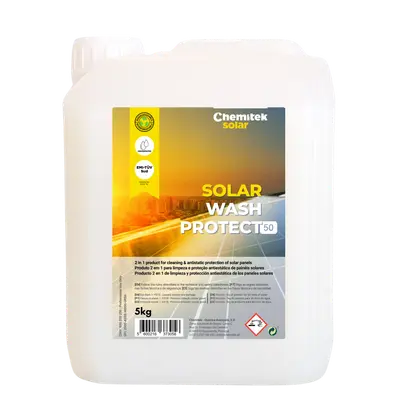
| Solar Wash Protect | Manual and rotary brushes, water-fed poles, robots, tractors | 1:50 sprayed ahead of the brush; 1:150 dosed into a water-driven rotary brush; 1:150–1:250 in robot or tractor water for heavy soiling, then rinsed |
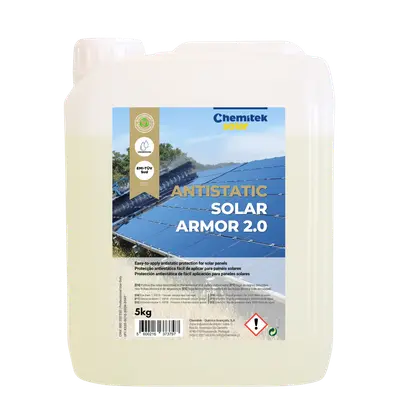
| Antistatic Solar Armor 2.0 and D-Solar Defendor | Water-fed poles, rotary brushes, robots, tractors | A fixed 1:1000 in the tank or through a dosing pump, with no rinse; D-Solar Defendor in soft water; not by manual brush (Chemitek) |
| Inorganic Removal Agent | Sprayer with a manual or rotary brush; robot or tractor with a sprayer | Sprayed on dry glass, brushed in without water, then rinsed; with a robot, the spray goes on just ahead and the robot drives slowly |
| Lichen Removal Agent | Sprayer and brush | 1:10, left to soak 10–20 minutes, then brushed and rinsed |
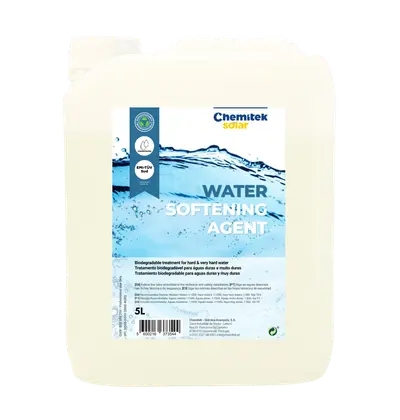
| Water Softening Agent | Any wet method | Dosed by measured hardness, in the tank or in line |
| Drone Solar Cleaning Agent | Drone, by tank or hose | 1:50–1:150, left up to 5 minutes without drying, then rinsed with demineralised water |
Loose dust comes off with most methods. Bonded soiling needs a removal agent, with harder bristles where the module maker allows them (Chemitek). A dry robot can’t restore cured cement; a wet robot or tractor can, with a sprayer ahead. See cement dust.
Dosing pumps and water treatment
A dosing pump holds the ratio across a whole site. Chemitek specifies water-powered pumps by product: a 0.03–0.3% model for Antistatic Solar Armor 2.0, D-Solar Defendor and Water Softening Agent, and a 0.2–2% model for Solar Wash Protect 50. A bypass switches the crew to plain water for rinsing, and pumps of this type are limited to 6 bar.
For hard water, Chemitek’s set-up puts a sediment and activated-carbon filter ahead of the pump that doses Water Softening Agent, with a dynamic mixer after it, and quotes up to 3,000 L of softened water an hour with no power supply. We check the water after the mixer with hardness test strips, because a TDS meter reads the softener itself and says nothing about hardness. See water testing.
Evidence from the field
- Tractor brush, Chile. At a 115 MWc single-axis tracker plant, D-Solar Defendor was mixed into the wash water and brushed onto three strings. Over six months, October 2020 to March 2021, they produced 2.41% more energy than three strings cleaned with water, and the tractor ran at 1.35 km/h instead of 1.1 km/h on the dry cleans that followed. Read the case study.
- Robot, Vietnam. On a 330 MW site, D-Solar Defendor was injected over the robot’s brushes. Three more cleans followed without reapplying it, the robot could run softer brushes and water use fell 15–25%. Read the case study.
A cement relay crew
For a ±15.6 MWp plant beside a cement works in North West Province, we built the equipment around the chemistry. A three-person relay crew works each row: one sprays Inorganic Removal Agent from a backpack sprayer, one agitates with a battery-powered dual rotating brush, which can brush without water where water-driven heads can’t, and one rinses with a water-fed rotating brush on softened water. A second, quick pass coats the clean row, with a dosing pump metering Antistatic Solar Armor 2.0 into the water and no rinse. See the programme or read the case study.
Chemitek products for this
- Clean + protectSolar Wash ProtectConcentrated PV cleaner that leaves an antistatic, anti-adherent layer. 18 module-maker letters of conformity.
- ProtectAntistatic Solar Armor 2.0Anti-soiling coatings dosed into the wash water at 1 kg to 1,000 L. At least 12 months of protection (Chemitek).
- PreventWater Softening AgentSoftens hard cleaning water in about 20 minutes, so rinses don’t leave scale.
Running your own crews? You can order just these products from us, with or without our engineers.


