Why is a small dropping a big problem?
Dust dims a whole module fairly evenly. A dropping does something different: it blocks the light to part of one cell completely. That cell can no longer carry the current the rest of the string pushes through it, so it heats up, and the bypass diode may switch on and take that section of the module out of the circuit.
Rain rarely helps. Droppings dry into a sticky crust that bonds to the glass, and light rain runs around it. Low-tilt rows, module bottom edges and rows under perches such as cables, fences, lighting masts and nearby roosts collect the most.
Scraping isn’t the answer either. Blades and abrasive pads remove the dropping by scratching the anti-reflective coating, and that damage is permanent.
What do bird droppings cost?
Researchers measured it on Eskom’s Rosherville PV plant in Johannesburg (Vumbugwa et al. 2020):
| Soiling | Cell temperature rise | Effect on the string |
|---|---|---|
| One bird dropping on one cell | +11.1 °C | Bypass diode switched on; string down 6 W (0.16%) |
| Dust along a module’s bottom edge | +18.4 °C | String down 0.18% |
The energy lost to one dropping is small. The heat is the problem: a cell running 11 °C hotter than its neighbours stays under stress for as long as the dropping stays, and droppings multiply quickly near roosts. NREL’s O&M best-practice guide reports soiling rates of up to 0.5% a day near bird colonies, against about 0.05% a day in typical conditions.
How we diagnose it
- Map the droppings. We walk the rows, photograph where droppings build up and note what the birds are perching on.
- Find the hot ones. Thermal images from your plant’s inspections show which droppings have already created hot spots, so those get cleaned first.
- Measure the effect. We compare string or inverter data from the affected rows with clean rows in the same irradiance. See site soiling assessment.
- Check the rest of the soiling. Droppings rarely come alone. We look for dust films and test the cleaning water, because hard water leaves scale wherever a spot-clean dries.
How we remove them
Soften, lift, rinse. Never scrape.
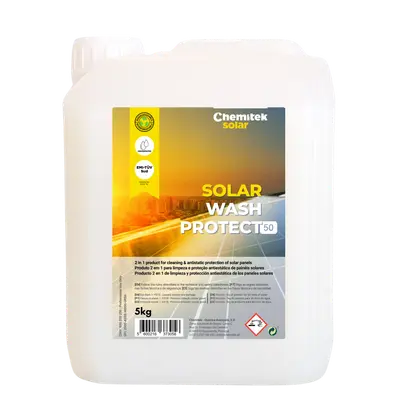
- Pre-wet each dropping with Chemitek Solar Wash Protect diluted in water (SWP 50 at 1 kg to 50 L) and give it time to soften.
- Brush gently with a soft brush until it lifts. Don’t press harder; let the solution work.
- Rinse with clean water; the rinse is essential. Squeegee or leave to dry, and use diluted solution within 48 hours.
- Stay within the pressure limit your module maker sets.
Solar Wash Protect lifts dust, pollen, bird droppings and organic soiling without abrasion, and leaves an antistatic, anti-adherent layer behind. It is pH 7 ± 1, readily biodegradable (Chemitek) and tested by ÉMI-TÜV SÜD, and it carries letters of conformity from 18 module makers, including LONGi, JA Solar, Trina, Jinko and Canadian Solar, valid within their cleaning conditions. It works with manual brushes, rotary brushes, robots and tractor-mounted brushes, so your own crews can use it: order just the product. See Solar Wash Protect.
How to stop them coming back
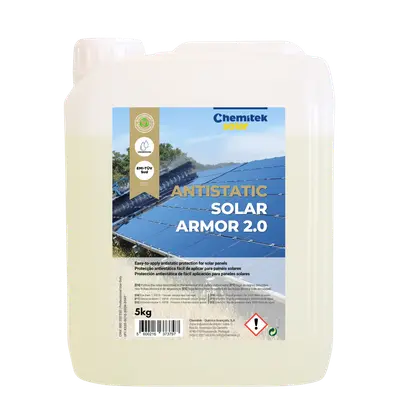
- Make them release. SWP’s anti-adherent layer means new droppings bond less strongly; Chemitek reports about six months of protection. On plants cleaned by robot or tractor brush, Antistatic Solar Armor 2.0, dosed at 1 kg to 1,000 L of cleaning water, gives at least 12 months (Chemitek). A coating makes droppings easier to remove; it doesn’t keep birds away. See anti-soiling coatings.
- Spot-clean on a schedule. Between full washes, a quick pass over the known dropping zones stops hot spots sitting for weeks. We set that interval from what we measure: see cleaning strategy.
- Deter at the source. Deterrents are a pest-control specialist’s job. Our map of where droppings land tells them where it pays to act.
The evidence
Eskom Rosherville, Johannesburg. The measurements above are independent and South African: one dropping, one cell, 11.1 °C hotter and a bypass diode on (Vumbugwa et al. 2020).
Solar Wash Protect against water-only cleaning. No published case study isolates bird droppings, so we don’t claim one. Chemitek’s cases do show SWP against plain water on working plants:
- Case study: Chemitek (Portugal), with Scatec, Honduras. On road dust, Solar Wash Protect beat water-only cleaning on a utility plant. See the Honduras case.
- Case study: Chemitek (Portugal), with TNBES, Malaysia. On organic dust with high-TDS well water, Solar Wash Protect beat water-only cleaning. See the Malaysia case.
Coated glass and harsh spots. On a 330 MW plant in Vietnam whose soiling occasionally included bird droppings, crews cleaning strings coated with D-Solar Defendor reported that they no longer had to go back over spots of harsher soiling, such as droppings (Case study: Chemitek (Portugal), with BIM AC Renewables). That is what the crews reported; the droppings weren’t measured separately. See the Vietnam case.
Droppings on your strings? Utility-scale and large C&I plants qualify for a free pilot: treated strings against control strings, under the same sun.
Chemitek products for this
- Clean + protectSolar Wash ProtectConcentrated PV cleaner that leaves an antistatic, anti-adherent layer. 18 module-maker letters of conformity.
- ProtectAntistatic Solar Armor 2.0Anti-soiling coatings dosed into the wash water at 1 kg to 1,000 L. At least 12 months of protection (Chemitek).
Running your own crews? You can order just these products from us, with or without our engineers.


