
South Africa’s CSP fleet
All of South Africa’s CSP is in the Northern Cape: seven plants and 600 MW at 30 June 2025 (van Zyl et al. 2025; CSIR 2025).
| Plant | Capacity |
|---|---|
| KaXu | 100 MW |
| Khi | 50 MW |
| Bokpoort | 50 MW |
| Xina | 100 MW |
| Ilanga-1 | 100 MW |
| Kathu | 100 MW |
| Redstone | 100 MW |
To the end of 2023, the fleet produced 10.1 TWh, about 81% of its expected P50 output (van Zyl et al. 2025). That figure covers every cause, not only soiling. But mirror cleanliness is a lever the O&M team controls every day, and we found no published cleaning data for South African CSP plants. Each plant’s own measurements are the only guide.
Why mirrors need tighter control
A concentrating collector only uses light reflected accurately onto the receiver, and dust scatters light away from it. The same soiling costs a CSP plant 8–14 times more energy than a PV plant (Ilse et al. 2019). Mirrors also soil fast:
| Site | What was measured | Source |
|---|---|---|
| Emalahleni, near a ferromanganese smelter | Test mirrors lost on average 32.6% of their reflectance per 14 dry-season days; the best site was 13.1% better than the worst, and the first rains helped | Swart et al. (2023) |
| Plataforma Solar de Almería, Spain | Mirror soiling averaged 0.52% a day, with a maximum of 8.9% a day; with fortnightly cleaning, cleanliness never fell below 82% | Wolfertstetter et al. (2018) |
| SOLABEN, Spain: untreated mirrors | Reflectivity fell 2.44% in 11 days (October 2021) and 2.17% in 10 days (July 2022) | Case study: Chemitek (Portugal), with Atlantica and Rio Glass Services |
The Northern Cape adds its own pressure: parts of the province get under 70 mm of rain a year (SAEON), so rain rarely does the washing for you.
Reflectance and wash triggers
- Reflectance is the measured fraction of light a mirror reflects, reported with its wavelength, incidence angle and acceptance angle. The SolarPACES Reflectance Guideline (v3.1, 2020) separates specular reflectance, the light a receiver can collect, from hemispherical reflectance, which also counts scattered light.
- Cleanliness factor is soiled reflectance divided by clean reflectance for the same mirror (SolarPACES). At 0.95, the mirror delivers 95% of what it would clean.
- Wash trigger is the cleanliness at which washing pays. A modelled optimum at Almería averaged 0.965 ± 0.013, with 0.97–0.98 cited as optimal (Wolfertstetter et al. 2018). Yours depends on your soiling rate, water and tariff.
We read sample mirrors across the field with a portable specular reflectometer: near roads and dust sources, at the upwind and downwind edges and in the centre, as found and after cleaning a small patch. Tracked over time, the readings give soiling rates by area and season. See CSP mirror reflectivity measurement.
Working with your O&M team. We don’t replace the plant’s O&M contractor. We measure reflectance, agree the wash triggers with your team, trial treatments on sample mirrors and train the wash crews. The contractor keeps the contract and the site. See working with your O&M team.
Water: the other half of the sum
South African CSP plants hold water-use licences of 1,397–17,900 m³ a year per MW. Actual raw-water use was 0.35–0.56 m³/MWh at four plants, and 1.9 and 4.5 m³/MWh at two others (van Zyl et al. 2025). For comparison, median operational water use at utility PV plants is about 0.10 m³/MWh (Macknick et al. 2011).
A wash that didn’t need doing spends water from the licence; a late wash spends energy. Reflectance data lets you avoid both. See low-water cleaning.
Mirtek between washes
Chemitek Mirtek adds an antistatic, anti-adherent layer to the mirror during the normal wash. In a trial at the SOLABEN CSP plant in Extremadura, Spain (Case study: Chemitek (Portugal), with Atlantica and Rio Glass Services), reflectivity readings on treated and untreated collectors showed treated mirrors losing reflectivity far more slowly:
| Application | Treated mirrors | Untreated mirrors | Loss rate |
|---|---|---|---|
| Jetwash (October 2021) | 0.40% lost in 10 days | 2.44% lost in 11 days | 6× slower |
| Brush (July 2022) | 0.16% lost in 10 days | 2.17% lost in 10 days | 13× slower |
Seventeen days after jetwash application, treated mirrors had lost 1.34%. After brush application, reflectivity recovered to its initial level in several cases, and Chemitek recommends the brush. Read the SOLABEN case. Chemitek’s datasheet doses Mirtek at 1 kg to 900 L of distilled or demineralised water, to be used within 12 hours, and Chemitek states it suits all types of CSP mirror. Buy it from us for your wash crews, or have us trial it on sample mirrors and measure the difference first. See Mirtek.
Chemitek products for this
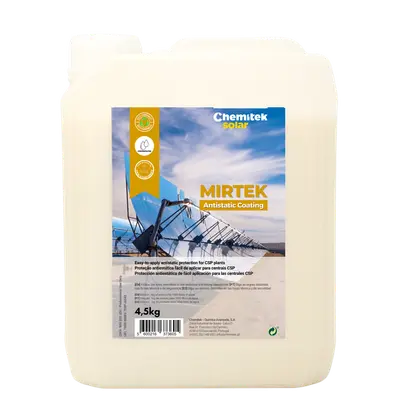
Running your own crews? You can order just these products from us, with or without our engineers.


