
Why does cleaning water matter?
Every wash leaves something behind as the water dries. With soft water, that is almost nothing. With hard water, it is calcium and magnesium: spots and haze that build up wash after wash. In a Chemitek case study at an 850 kWp plant in Malaysia, a string washed with high-TDS well water produced 4.9% less than the three-string average after cleaning. The wash made it dirtier (Case study: Chemitek (Portugal), with TNBES).
Water is also scarce. South Africa averages about 490 mm of rain a year, roughly half the world average (WWF-SA). At 1–3 L/m² per wash (NREL 2018; Naicker 2018), one wet wash of a 10 MWp plant uses roughly 50–150 m³. Every litre should clean.
Hardness is not the same as TDS
- TDS (total dissolved solids) is everything dissolved in the water: calcium, magnesium, sodium, chloride and more. A TDS meter estimates it from conductivity.
- Hardness is the calcium and magnesium part. It is the part that forms scale.
- Module makers limit both. First Solar allows TDS below 1,500 mg/L but prefers hardness below 75 mg/L, so water can pass one limit and fail the other.
- A TDS meter can’t check softened water. Once Water Softening Agent is in the tank, the meter reads the additive too and says nothing about the actual hardness. Chemitek says to use hardness test strips instead.
What do module makers allow?
We read the current cleaning or installation manuals of 23 module makers. Nine give a numeric hardness limit for cleaning water:
- Trina, as CaCO₃600
- Aiko, as CaCO₃600
- LONGi450
- Jinko450
- First Solar, preferred75
- Risen40
- DAS Solar40
- Huasun, as Ca and Mg ions40
- Znshine, as Ca and Mg ions40
From each maker’s current manual. The bases differ, so the bars are not like for like (see the units, below). The other 14 makers publish no number.
| Module maker | Hardness limit and basis | TDS | pH | Source (year) |
|---|---|---|---|---|
| Trina | ≤600 mg/L as CaCO₃; soft water recommended | Not stated | 6–8 | Vertex Series user manual, Ver. L (2024) |
| Aiko | <600 mg/L as CaCO₃ | Not stated | 6–8 | Installation manual 2503V15 (2025) |
| LONGi | 0–450 mg/L; basis not stated | ≤1,000 mg/L | 6–8 | O&M manual V2.0 (2024) |
| Jinko | ≤450 mg/L; basis not stated | ≤1,000 mg/L | 6.5–8 | Cleaning manual v1.0 (2024) |
| First Solar | <75 mg/L preferred; 75–180 mg/L only on uncoated modules, squeegeed dry, and prohibited on ARC-coated modules; basis not stated | <1,500 mg/L | 6.5–8.5, for the final water-and-detergent mix at 25 °C | Module cleaning guidelines PD-5-804 Rev 3.4 (2017) |
| Risen | 0–40 mg/L; basis not stated | ≤1,000 mg/L | 5–7 | Installation and maintenance manual (2023) |
| DAS Solar | 0–40 mg/L; basis not stated | ≤1,000 mg/L | 5–7 | User manual V10 (2025) |
| Huasun | 0–40 mg/L as calcium and magnesium ions | ≤1,000 mg/L | 5–7 | Installation manual (2024), distributor-hosted copy |
| Znshine | 0–40 mg/L as calcium and magnesium ions | ≤1,000 mg/L | 6–8 | Single-glass installation manual (2024) |
The other 14 publish no numeric hardness limit: Canadian Solar, JA Solar, Tongwei (TW Solar), Suntech, Yingli, DMEGC, Runergy, Seraphim, GCL, Astronergy, Hanwha Q CELLS, REC and Maxeon (SunPower). Several describe the water in words instead: low-mineral, soft, potable or deionised. The full table, with pH and pressure for every maker, is in water quality for solar panel cleaning. Pressure, brush and temperature limits are in warranty-safe methods. Makers revise their manuals, so we always check the current one for your exact module series.
Watch the units before you compare
Hardness figures are not all measured on the same basis, and the raw numbers mislead if you mix them.
- As CaCO₃. Trina and Aiko state their limits as calcium carbonate, the way most water labs report hardness.
- As ions. Huasun and Znshine state theirs as the mass of the calcium and magnesium ions themselves. The same water reads lower that way: converted to CaCO₃, calcium roughly multiplies by 2.5, and magnesium by more.
- Not stated. LONGi, Jinko, First Solar, Risen and DAS Solar give a number in mg/L without saying which basis it uses.
So a 0–40 mg/L limit as ions is not the fifteen-fold tighter rule it looks like next to Trina’s 600 mg/L as CaCO₃. Before you compare, check that your water report and the maker’s limit use the same basis. Our reports state it.
First Solar needs a closer read, too. Its 2017 guidelines prefer reverse-osmosis water, or tap water under 75 mg/L total hardness. Water of 75–180 mg/L is allowed only on uncoated modules, and only if it is squeegeed off; on modules with an anti-reflective coating it is prohibited. The guidelines don’t cover water above 180 mg/L.
What we test on site
- Hardness, with hardness test strips, reported as mg/L of CaCO₃. This is the reading that decides whether the water will scale.
- TDS and pH, against your module maker’s limits.
- At the point of use: the bowser or tank the crew actually cleans from, and every source you draw on, whether borehole, municipal, tanker or RO plant.
- Against your manual, for your exact module make and series, on the same basis.
- After treatment, to confirm the water is now inside the limits.
How to fix hard water
| Option | What it does | Suits |
|---|---|---|
| Water Softening Agent | Captures calcium and magnesium ions so nothing deposits as the rinse dries; works in about 20 minutes, dosed into the tank or in real time through a dosing pump | Plants with hard borehole or municipal water; works with other Chemitek products |
| Reverse-osmosis (RO) or deionised water | Removes most dissolved solids | Sites that already run an RO plant; coatings that need soft water, such as D-Solar Defendor |
| No treatment | – | Water already inside your module maker’s limits |
Chemitek sets the Water Softening Agent dose by measured hardness, which is why the test comes first. It prevents new scale; it doesn’t remove scale already on the glass. For existing stains, Chemitek Inorganic Removal Agent also dissolves hard-water deposits: see hard-water deposits. Water Softening Agent carries three module-maker letters of conformity (Chemitek). If you already know your hardness, you can order just the product and dose from Chemitek’s table.
A worked example: water at 250 mg/L
Say your borehole water tests at 250 mg/L as CaCO₃. On the USGS scale, anything above 180 mg/L as CaCO₃ counts as very hard. Against the makers above, that water:
- sits inside Trina’s and Aiko’s 600 mg/L as CaCO₃;
- sits inside LONGi’s and Jinko’s 450 mg/L, if those figures are also as CaCO₃, which their manuals don’t say;
- is above anything First Solar’s guidelines allow;
- is well above the 0–40 mg/L ion limits of Huasun and Znshine, even after converting.
The same water passes one maker’s manual and fails another’s, so your module maker’s manual, read on the right basis, decides. Even inside a limit, hard water leaves scale as each rinse dries, which is why we usually soften it before it goes on the glass. The Malaysia case shows what happens when nobody checks the water first: the string washed with untreated well water ended up producing less than the string nobody washed.
Chemitek products for this
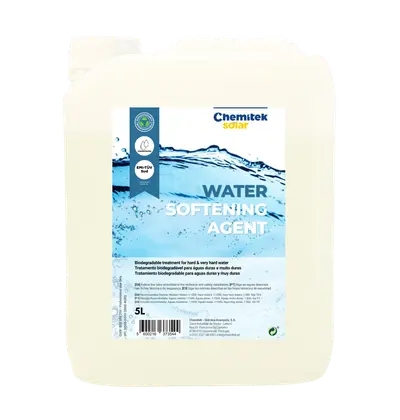
- PreventWater Softening AgentSoftens hard cleaning water in about 20 minutes, so rinses don’t leave scale.
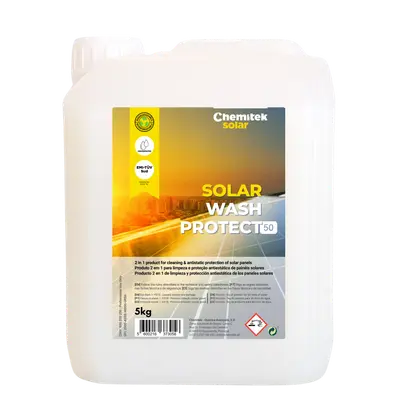
- Clean + protectSolar Wash ProtectConcentrated PV cleaner that leaves an antistatic, anti-adherent layer. 18 module-maker letters of conformity.
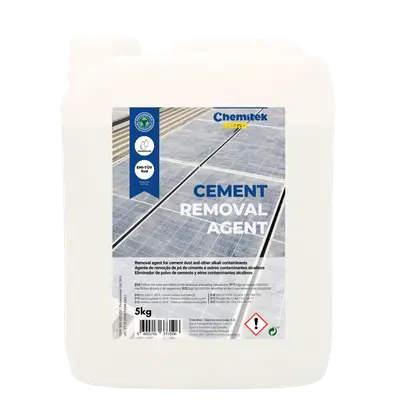
- RestoreInorganic Removal AgentDissolves cured cement dust, stone dust and gypsum that water can’t shift. 8 module-maker letters of conformity.
Running your own crews? You can order just these products from us, with or without our engineers.


