
Why won’t rust wash off?
Rust stains start as metal on the glass: iron-rich dust from mines, smelters and steelworks, run-off from corroding steel above or beside the array, or hot particles from grinding and welding nearby. Moisture oxidises the metal, and the oxide bonds to the glass as orange-brown spots, speckles and streaks. Iron oxide doesn’t dissolve in water, so rinsing and brushing leave it behind, and scrapers or abrasive pads take the anti-reflective coating with it.

On the rooftop in Chemitek’s Türkiye case, everything from conventional washing to cleaning robots with powerful brushes had failed to clear the metal oxides bonded to the glass. Aluminium-oxide residues are a related problem, and the same remover handles them.
What do metal oxides cost?
| Setting | Finding | Source |
|---|---|---|
| Rooftop PV, İzmir, Türkiye, metal dust cured on the glass | Produced 12.64% less than expected, on average, before treatment (March–August 2024) | Chemitek case study |
| CSP test mirrors near a ferromanganese smelter, Emalahleni | Lost 32.6% of their reflectance, on average, per 14 dry-season days | Swart et al. (2023) |
| PV modules under iron-ore mine dust, India | 63.5% lower maximum power at 5.98 g/m² | Tripathi et al. (2026) |
The last two studies measured dust deposits rather than bonded stains, and the smelter study measured mirrors rather than PV modules. They show how quickly metal-rich industrial dust builds up, and how much light it can take. Put your own figures into the soiling loss calculator.
How we diagnose it
- Read the pattern. Streaks below steelwork point to run-off; an even orange speckle to airborne dust; tiny embedded specks to grinding or welding.
- Find the source. What is upwind and overhead, and when did the staining start? Stains that appear after construction or maintenance work point to hot work nearby.
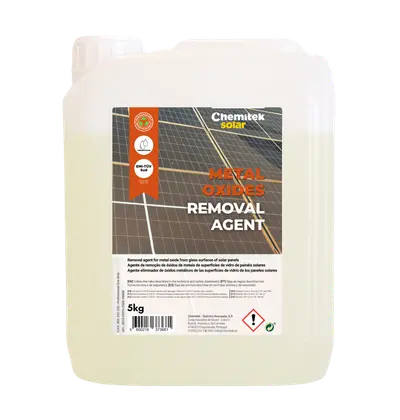
- Run a test patch. Metal Oxides Removal Agent at 1:10 on a small area shows whether the stain moves, or needs 1:5.
- Test the water. Iron in the cleaning water adds new stains every time a rinse dries. See water-quality testing.
- Measure the loss. We compare affected strings with clean ones in the same irradiance. Where every panel is stained, we clean a reference module first so there is a baseline. See site soiling assessment.
How we remove it
Chemitek Metal Oxides Removal Agent (MRA) removes rust and other metal-oxide stains, including aluminium-oxide residues, from module glass. It breaks the oxide down chemically instead of abrading it, which spares the anti-reflective coating.
- Test a small area first.
- Start at 1:10. If the stain holds, strengthen to 1:5. Chemitek’s datasheet keeps anything stronger than 1:5 for very extreme cases.
- Keep the treated glass wet until you brush and rinse. Solution that dries on the glass means repeating the job.
- Brush with a soft brush and rinse thoroughly with clean water.
MRA’s biodegradability was tested to OECD 301F by CVR, Portugal’s Centre for Waste Valorisation. It is named in JA Solar’s 2025 letter of conformity for Chemitek products and has been tested by ÉMI-TÜV SÜD. Chemitek packs it in 2 kg, 5 kg and 20 kg containers and IBCs. MRA doesn’t have its own page on our site yet: it is in the Chemitek range, and you can ask us for it.
How to stop it coming back
- Remove the source. Treat, paint or replace corroding steel near the array, and keep grinding and welding away from the modules, or cover them during hot work.
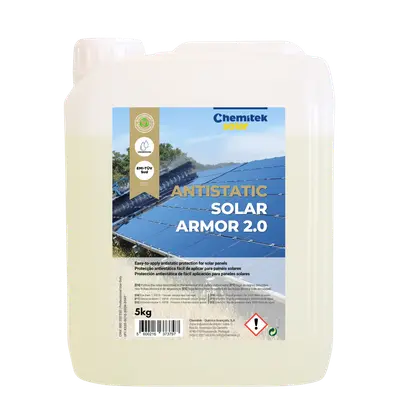
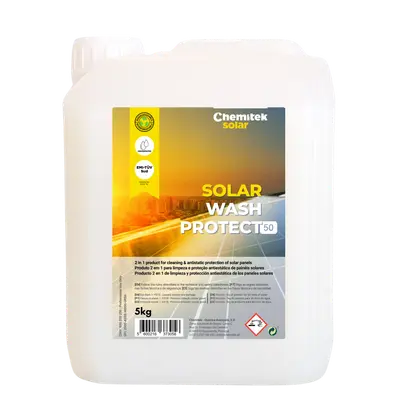
- Protect the glass. Chemitek recommends following MRA with Solar Wash Protect or Antistatic Solar Armor, so new oxides bond less strongly and come off more easily at the next clean. On robot- or tractor-cleaned plants, ASA 2.0 is dosed at 1 kg to 1,000 L of cleaning water; on manually cleaned sites, Solar Wash Protect is the better fit. See anti-soiling coatings.
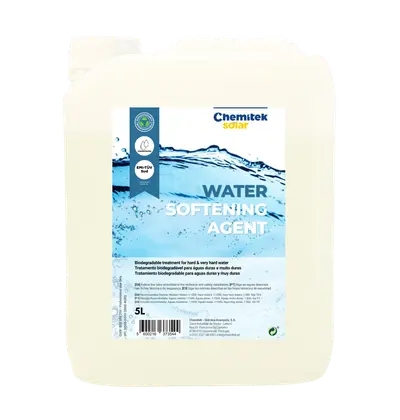
- Treat the water. If the water carries iron, treat it before it reaches the glass. Chemitek’s ion-capture chemistry, used for hard water, captures iron as well as calcium and magnesium. See Water Softening Agent.
- Inspect more often near active industry, and set the cleaning interval from measured soiling rather than the calendar.
The evidence
Case study: Chemitek (Portugal), with Eco Cover Energy, İzmir, Türkiye. 1,230 rooftop panels with metal dust cured on the glass, treated over a 60-day trial with MRA at 1:1 and neat, because the contamination was severe. Before treatment (March–August 2024), the plant produced 12.64% less than expected, on average. After treatment (September 2024–February 2025), the shortfall averaged 3.76%: a recovery of about 8.9 percentage points.
Read it with two cautions. Expected output came from an external benchmark, because every panel on the roof was contaminated and no clean reference was possible. And the before and after periods fall in different seasons. That is why, on your plant, we measure against control strings under the same sun.
Metal staining on your plant? Utility-scale and large C&I plants qualify for a free pilot: treated strings against control strings, under the same sun.
Chemitek products for this
- RestoreMetal Oxides Removal AgentDissolves rust and metal-oxide stains. Start at 1:10, 1:5 if the stain holds. Ask us for the datasheet and pricing.
- ProtectAntistatic Solar Armor 2.0Anti-soiling coatings dosed into the wash water at 1 kg to 1,000 L. At least 12 months of protection (Chemitek).
- Clean + protectSolar Wash ProtectConcentrated PV cleaner that leaves an antistatic, anti-adherent layer. 18 module-maker letters of conformity.
- PreventWater Softening AgentSoftens hard cleaning water in about 20 minutes, so rinses don’t leave scale.
Running your own crews? You can order just these products from us, with or without our engineers.


