
Why C&I cleaning is its own job
South Africa’s rooftop (embedded) PV grew from about 5,600 MW in mid-2024 to about 6,800 MW in mid-2025 (CSIR 2025). All solar PV, counting utility, C&I and distributed systems, reached 10.12 GW by July 2026 (SAPVIA). A commercial or industrial roof is not a small solar farm, though:
- Access. Crews work at height, often beside fragile roof sheeting, or above parked cars on a carport.
- Neighbours. Factories, workshops, kitchens and building sites put cement, soot, oil and grease on nearby glass, and birds use roof edges.
- Water. You wash with whatever the building has: municipal, borehole or tanker water, and it may be hard.
- Value. A clean is worth the tariff you avoid, so the sums differ from a REIPPPP plant’s.
Patchy soiling, such as bird droppings, matters more than it looks.
Which chemistry for which contaminant?
| Contaminant | Chemitek product | Chemitek’s method |
|---|---|---|
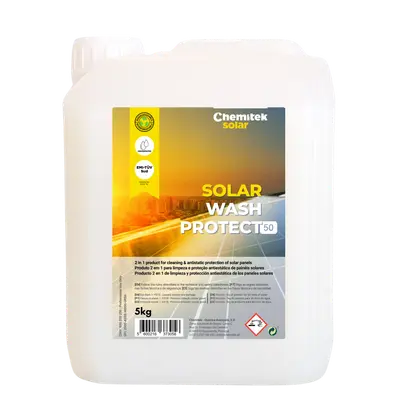
| Dust, pollen, droppings, road grime | Solar Wash Protect (SWP 50) | 1 kg to 50 L of water, about 150–200 mL/m²; brush, then rinse |
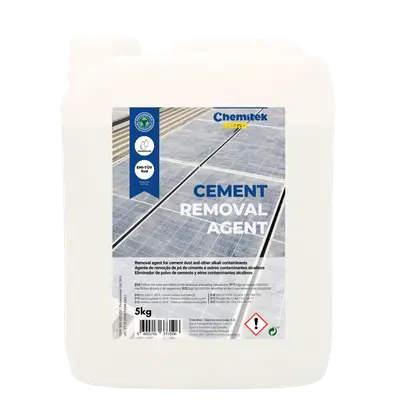
| Cured cement, stone dust, gypsum, hard-water stains | Inorganic Removal Agent | Start at 1 kg to 2 L on dry glass; brush in, then rinse |
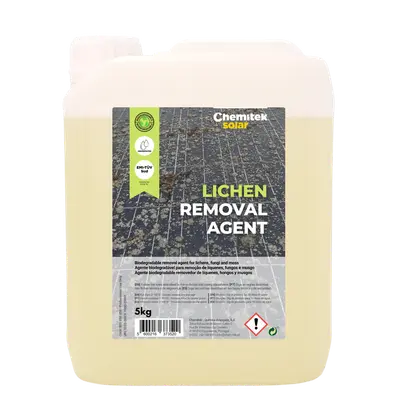
| Lichen, moss and fungi | Lichen Removal Agent | 1 kg to 10 L; soak 10–20 minutes, brush, rinse |
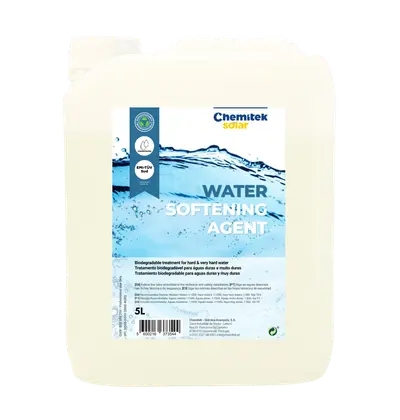
| Hard wash water | Water Softening Agent | Dosed into the tank to the measured hardness |
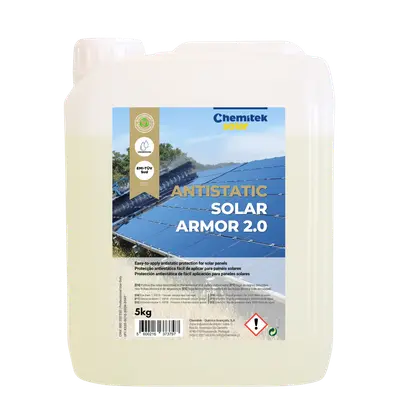
| Re-soiling after a clean | Antistatic Solar Armor 2.0 | 1 kg to 1,000 L through rotary brushes or robots, not by manual brush |
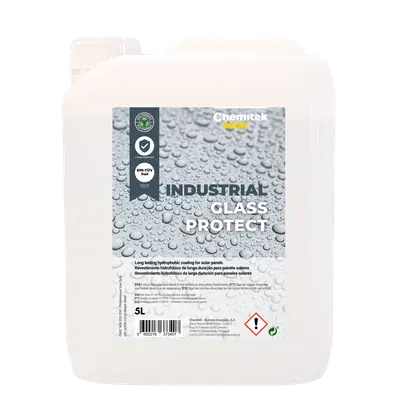
Chemitek’s PV products were tested by ÉMI-TÜV SÜD for safety on module glass, anti-reflective coatings and frames. Chemitek describes Solar Wash Protect as readily biodegradable, with biodegradability tested to OECD 301F by Portugal’s CVR. For façades and skylights on the same building, Industrial Glass Protect is a ready-to-use hydrophobic coating applied at 5–10 mL/m². See Chemitek products explained.
Warranty and water
Warranty-safe means inside the maker’s conditions
A letter of conformity is a module maker’s written confirmation that a named product may be used on its modules. It is not a blanket guarantee: LONGi’s sample letter says so, and sets conditions of wet cleaning only, a water-pressure limit, the brush type and trained staff. Pressure, brush and temperature limits differ by maker, so we read your module maker’s current manual before choosing a brush or a pump. See warranty-safe methods and cleaning and your module warranty.
Test the water before it marks the glass
Module makers limit what you wash with, and not all on the same basis. Hard water leaves calcium and magnesium scale as each rinse dries. We test on site with hardness strips, because a TDS meter can’t read softened water, then soften with Water Softening Agent or switch to reverse-osmosis water. See water-quality testing and the Malaysia case.
Access and safety
- Work from the safest position. Water-fed poles from a walkway or roof edge, manual brushes where people can stand safely, and drone cleaning where the roof is steep, fragile or has no safe route.
- Fit the building’s safety system. Permits, induction and fall protection come first, with a method statement and safety data sheets for your HSE file.
- Keep water off the electrics. No high-pressure jets on frames, seals or junction boxes.
- Clean cool glass. Work early, late or under cloud, and keep wash water close to the module temperature.
- Carports. Plan around the cars and people underneath, and where the run-off goes.
The evidence
Case study: Chemitek (Portugal), with Soleden Power, India. A commercial rooftop plant inside an industrial complex, soiled by greasy factory fumes and fine dust and cleaned by hand. In a one-month test on two strings of six panels, the string cleaned and protected with Solar Wash Protect averaged 5.1% more energy than the water-cleaned string over 16 consecutive days. The sample is small, so read it as an indication. See the India case.

Case study: Chemitek (Portugal), with Ecomundo, Chile. A 48 kWp carport beside a precast-concrete factory, where water had failed. Ecomundo treated 45 modules with Inorganic Removal Agent and then Antistatic Solar Armor, against 45 cleaned the traditional way. See the Chile case.

Case study: Chemitek (Portugal), with TNBES, Malaysia. Washed in the same high-TDS well water, Solar Wash Protect beat water-only cleaning. See the Malaysia case.
Running a large C&I site? It qualifies for a free pilot: treated strings against untreated ones, under the same sun.
Chemitek products for this
- Clean + protectSolar Wash ProtectConcentrated PV cleaner that leaves an antistatic, anti-adherent layer. 18 module-maker letters of conformity.
- RestoreInorganic Removal AgentDissolves cured cement dust, stone dust and gypsum that water can’t shift. 8 module-maker letters of conformity.
- RestoreLichen Removal AgentLoosens lichen, moss and fungi from module glass so they brush off. 4 module-maker letters of conformity.
- PreventWater Softening AgentSoftens hard cleaning water in about 20 minutes, so rinses don’t leave scale.
- ProtectAntistatic Solar Armor 2.0Anti-soiling coatings dosed into the wash water at 1 kg to 1,000 L. At least 12 months of protection (Chemitek).
- ProtectIndustrial Glass ProtectReady-to-use hydrophobic coating for façades and solar glass, 5–10 mL/m². Up to five years (Chemitek).
Running your own crews? You can order just these products from us, with or without our engineers.


