
What changes at utility scale?
South Africa had 2,287 MW of utility-scale PV under REIPPPP at 30 June 2025, beside 600 MW of CSP and 3,807 MW of wind (CSIR 2025). IRP 2025 plans 10,313 MW of new PV capacity for 2026–2030 (DMRE). At solar-farm scale, three things change:
- Water. A wet clean uses about 1–3 L per m² of module (NREL 2018; Naicker 2018). A 10 MWp plant has roughly 48,000–55,000 m² of modules, so one full wash takes about 50–150 m³, by our calculation from Ilse et al. (2019).
- Variation. Soiling can vary across a single site, so one sensor or one inspected row can mislead. See soiling measurement.
- Money. What a clean is worth depends on the tariff you sold at: R4.39/kWh in bid window 1, but R0.49/kWh in bid window 6 (IPP Office; gov.za).
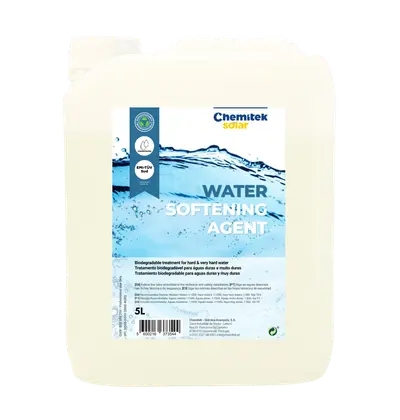
Water logistics. Whatever your source, test it at the bowser against your module maker’s limits, on the same basis. Hard water leaves scale as each rinse dries; Chemitek Water Softening Agent prevents it. See water-quality testing.
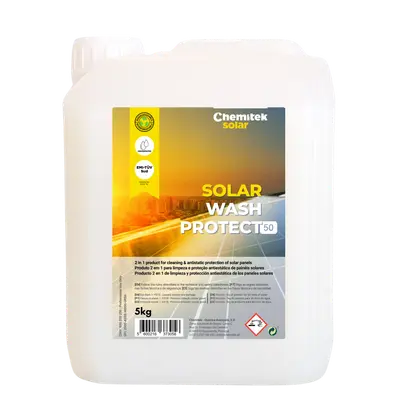
To use less, dry-clean loose dust and keep wet washes for what dry brushing can’t lift. Chemitek claims up to 50% less water with Solar Wash Protect; we measure your saving before we quote it.
What is one clean worth on your plant?
Between plants, the tariff moves the value of a clean most:
| Bid window | PV tariff | Value of 1% soiling loss a year |
|---|---|---|
| BW1 | R4.39/kWh | ≈R0.87 million |
| BW4 | R1.10/kWh | ≈R0.22 million |
| BW6 | R0.49/kWh | ≈R0.10 million |
The values are illustrative, for a 10 MWp fixed-tilt plant near Upington producing about 19.9 GWh a year (Global Solar Atlas). BW1 and BW4 tariffs are in April-2020 rands and partly CPI-indexed; BW6 is as announced (IPP Office; gov.za).
Run your own numbers in the soiling loss calculator, or read how often to clean a utility-scale plant.
Measuring soiling on a large site
We place sensors where soiling differs: downwind of dust sources, near roads, and in a clean block for contrast. Keep the irradiance reference clean, too. IEC 61724 recommends cleaning irradiance sensors weekly, and with a clean plane-of-array sensor, temperature-corrected performance ratio can give a good estimate of soiling in dry seasons (IEA PVPS 2022). See soiling measurement; on very large plants, a full plant study adds SCADA and performance-ratio analysis.
Trackers and fixed-tilt rows soil differently. Trackers and fixed-tilt rows need their own soiling rate. We don’t borrow a figure from another plant. We measure yours, with sensors in the plane of the modules, on the tracker where the plant tracks.
Mounting also limits the equipment: on trackers, the machine must suit the row height and tilt range.
Tractor, robot or crew?
| Method | Suits | Chemitek pairing | Watch |
|---|---|---|---|
| Tractor-mounted brush | Long rows with access roads; medium water use | Solar Wash Protect; ASA 2.0 or D-Solar Defendor dosed into the tank | Row spacing and ground conditions |
| Cleaning robot | Long, uniform rows cleaned often; water-scarce sites, as it uses little or no water | ASA 2.0, D-Solar Defendor | €2.4–8.2/m² capital cost and >95% soiling removal (Ilse et al. 2019); dry robots won’t lift cemented dust |
| Crew with battery rotary or manual brushes | Restoring bonded soiling, spot work, blocks machines can’t reach; low to medium water use | Inorganic, Lichen or Metal Oxides Removal Agent; Solar Wash Protect | Slow on large areas; brush type and pressure set by the module maker |
A coating can speed the machine up. See the Santiago tracker plant and the Vietnam robot-cleaned plant. See equipment selection.
Evidence, then your own strings
On a 330 MW plant in Vietnam, cleaned by robot, strings coated with D-Solar Defendor produced more energy than water-cleaned strings in both the dry and the rainy season, over a year of monitoring. See the Vietnam case.
On road dust at a Scatec-operated plant in Honduras, Solar Wash Protect beat water-only cleaning. See the Honduras case.
Prove it on your own strings. Utility-scale plants qualify for a free pilot: treated strings against control strings under the same sun, with water use and cleaning time recorded.
What the pilot shows depends on what is on the glass. Almost every plant carries soiling: the dust, sand and pollen that build up between cleans. Solar Wash Protect, or a coating such as Antistatic Solar Armor 2.0 or D-Solar Defendor, in the normal clean adds a few percent, as in Vietnam and Honduras above. Plants with contamination, such as cement, hard-water scale or lichen bonded to the glass, lose more and usually gain the most. See the Dubai case.
Chemitek products for this
- Clean + protectSolar Wash ProtectConcentrated PV cleaner that leaves an antistatic, anti-adherent layer. 18 module-maker letters of conformity.
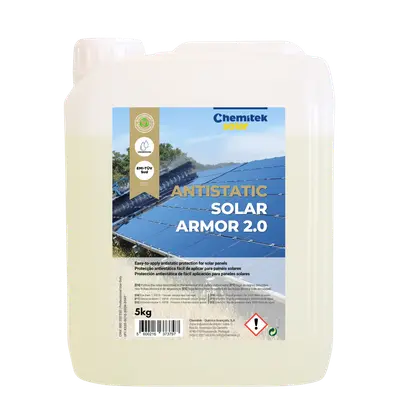
- ProtectAntistatic Solar Armor 2.0Anti-soiling coatings dosed into the wash water at 1 kg to 1,000 L. At least 12 months of protection (Chemitek).
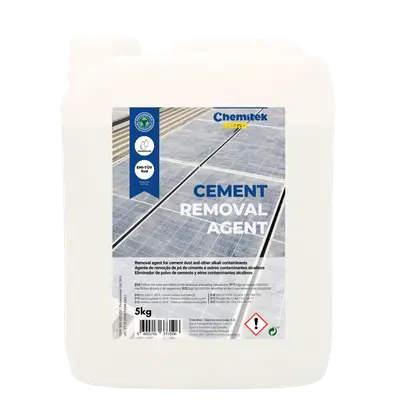
- RestoreInorganic Removal AgentDissolves cured cement dust, stone dust and gypsum that water can’t shift. 8 module-maker letters of conformity.
- PreventWater Softening AgentSoftens hard cleaning water in about 20 minutes, so rinses don’t leave scale.
Running your own crews? You can order just these products from us, with or without our engineers.


