
Why doesn’t lichen wash off?
Lichen is a fungus living in partnership with an alga or a cyanobacterium. It anchors itself to the glass surface, the frame and the sealant along the edges, survives long dry spells, and starts growing again when moisture returns. Moss and algae take hold the same way wherever water and dirt collect. A wash strips the loose surface growth and leaves the anchored part behind, so it grows back.

It takes hold where panels stay damp: shaded rows, arrays near trees or other vegetation, humid and high-rainfall sites, low edges where water sits, and older installations where growth is already established.
Left alone, it gets harder to remove. A review of PV soiling in Joule notes that lichens, fungi and cemented dust can become practically irremovable (Ilse et al. 2019). Scraping or hard brushing only swaps one loss for another: the anti-reflective coating.
What does biological growth cost?
Few published studies put a number on lichen alone, so we won’t invent one. What the evidence does show:
- Biological soiling costs real yield. Pollen, another biological soiling, cost 3–4% of yield in a Belgian study (Appels et al. 2013).
- Patchy growth shades parts of cells, which can create the same hot-spot risk as bird droppings.
- Established growth can become permanent (Ilse et al. 2019), turning a cleaning cost into a lasting loss.
On your plant, we measure it directly: affected strings against clean strings, under the same sun.
How we diagnose it
- Identify the growth. Lichen, moss, algae and pollen need different treatment. We map where each one sits: which rows, which edges.
- Find what feeds it. Shade from vegetation, water that doesn’t drain, debris packed against frames, low tilt.
- Run a test patch. Lichen Removal Agent on a small area shows the soak time needed and whether a second pass is required.
- Measure the loss. String current or inverter data from affected rows against clean rows in the same irradiance window, and soiling stations on larger sites. See site soiling assessment.
- Test the water. Hard rinse water leaves scale on freshly cleaned glass, and some coatings must be mixed with soft water.
What we find decides the treatment:
| Growth | Where it takes hold | How we remove it | Protection afterwards |
|---|---|---|---|
| Lichen | Glass, frames and sealant edges on shaded or damp rows | Lichen Removal Agent, 10–20 minute soak | ASA 2.0 or D-Solar Defendor |
| Moss | Frame edges and gaps where dirt and water collect | Lichen Removal Agent, then clear the debris | ASA 2.0 or D-Solar Defendor |
| Algae and fungal stains | Glass that stays damp | Lichen Removal Agent | ASA 2.0 or D-Solar Defendor |
| Pollen | Seasonal film across the array | Solar Wash Protect wash | SWP’s anti-adherent layer |
How we remove it
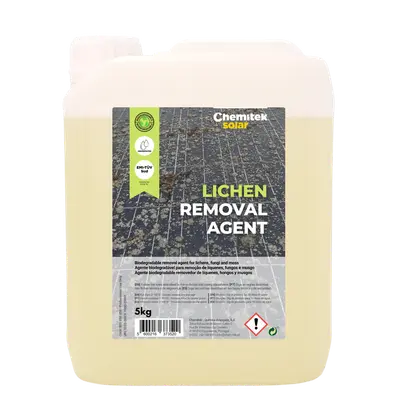
Chemitek Lichen Removal Agent (LRA) breaks the bond between lichen, moss or fungi and the glass, so the growth brushes off. It is designed to be gentle on the anti-reflective coating, silicone and aluminium frame. Chemitek’s datasheet method:
- Dilute 1 kg of LRA in 10 L of water.
- Spray the affected area. For severe growth, brush the solution over the whole surface.
- Leave it to soak for 10–20 minutes.
- Brush the growth off with a soft brush, repeating on stubborn patches.
- Rinse thoroughly with water, then protect the glass straight away.
LRA has been tested by ÉMI-TÜV SÜD and carries letters of conformity from 4 module makers, valid within their cleaning conditions. It is non-flammable and fully miscible with water. Shelf life: 3 years closed, 6 months once opened, 48 hours diluted. Packs: 2 kg, 5 kg and 20 kg. Your own crews can apply it: order just LRA and follow the method above. See Lichen Removal Agent.
How to stop it coming back
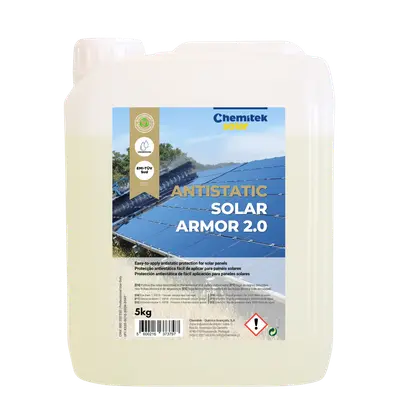
- Seal the glass. Straight after removal, apply Antistatic Solar Armor 2.0 (antistatic; 1 kg to 1,000 L of cleaning water, by rotary brush, robot or tractor) or D-Solar Defendor (hydrophobic; 1 kg to 1,000 L of soft water). Both need fully clean glass, and Chemitek reports at least 12 months of protection. On manually cleaned sites, Solar Wash Protect leaves an anti-adherent layer instead. See anti-soiling coatings.
- Take away the conditions. Trim vegetation that shades the array, clear debris from frame edges and fix water that pools.
- Inspect the rows at risk on a set interval, so growth comes off before it anchors. See Restore → Protect → Maintain.
Coatings don’t behave the same on every site. The IEA PVPS soiling report notes that some coatings add transmission loss or even increase soiling, so we test before a plant-wide roll-out.
The evidence
Chemitek has not published a lichen case study, and we won’t borrow one from another contaminant. The proof for Lichen Removal Agent on your plant is a pilot on your own strings. For the protection step, the field data is stronger:
Case study: Chemitek (Portugal), with Green Energy Park, Morocco. A nine-month field trial in Benguerir, peer-reviewed in Heliyon (2023) and co-authored by Green Energy Park and Chemitek staff. See the Morocco trial.

Case study: Chemitek (Portugal), with Girasol, Israel. On a cement-dust site, modules coated with ASA after cleaning still came fully clean two weeks later, while cement had stuck to the uncoated ones. See the Israel case.
Lichen on your array? Utility-scale and large C&I plants qualify for a free pilot: treated strings against control strings, under the same sun.
Chemitek products for this
- RestoreLichen Removal AgentLoosens lichen, moss and fungi from module glass so they brush off. 4 module-maker letters of conformity.
- ProtectAntistatic Solar Armor 2.0Anti-soiling coatings dosed into the wash water at 1 kg to 1,000 L. At least 12 months of protection (Chemitek).
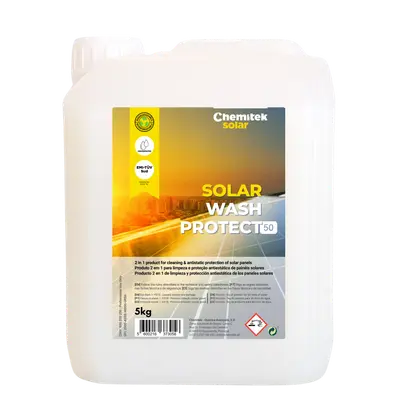
- Clean + protectSolar Wash ProtectConcentrated PV cleaner that leaves an antistatic, anti-adherent layer. 18 module-maker letters of conformity.
Running your own crews? You can order just these products from us, with or without our engineers.


