
When is a drone the right tool?
A drone earns its place where access is the problem: steep or fragile roofs, high façades and glazing, carports and canopies over parking bays, and arrays with no safe walkway.
| Situation | Drone | Crew, tractor or robot |
|---|---|---|
| Steep, fragile or high surfaces | Suits: nobody on the roof or the modules | Needs rope access, scaffolding or a lift |
| Open ground-mounted rows | Possible, but rarely the best fit | Usually the better fit |
| Cured cement, scale or lichen | Can’t brush: restore by hand first | Brushes and removal agents |
| Loose dust, routine maintenance | Suits, with the right agent | Suits |
A drone sprays; it doesn’t brush. Cured cement needs Chemitek Inorganic Removal Agent applied to dry glass and brushed in, so we restore bonded soiling by hand first and use the drone to keep it clean afterwards. Equipment selection compares the options, and a soiling assessment tells you which soiling you have.
Why hard-to-reach glass still matters. Soiling nobody can reach still costs output, and some of it creates hot spots. Bird droppings and edge dust can switch on bypass diodes. On a roof or canopy that crews can’t reach safely, that soiling stays until someone plans a safe way to clean it.
Chemitek’s drone range
| Product | Use | Dilution (Chemitek) |
|---|---|---|
| Drone Solar Cleaning Agent | PV modules; designed to clean without brushing | 1:50 up to 1:150 |
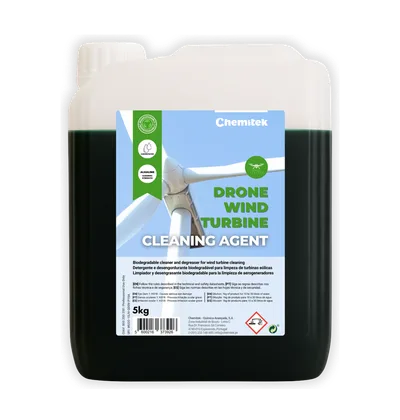
| Drone Wind Turbine Cleaning Agent | Blades, towers and nacelles: dust, grease, oil, soot and organic residue | 1:10 heavy, 1:20 medium, 1:30 light |
| Drone Spray-on Hydrophobic Coating | Water-repellent coating applied by drone | Ask us |
Drone Solar Cleaning Agent is alkaline, at pH 11–13, unlike Chemitek’s pH-neutral cleaners such as Solar Wash Protect (pH 7 ± 1). So we check it against your module maker’s cleaning conditions and letters of conformity before any use. See warranty-safe methods.
How we plan a drone clean
- Site survey. Surfaces, soiling type, water and power for the ground team, and hazards such as power lines, people and traffic.
- Approvals and permissions. The operator’s SACAA approvals, the site owner’s permission, a risk assessment and a method statement.
- Test area. Clean a small section, then check the result and the run-off.
- Application. The drone sprays the diluted agent at the rate set for the surface.
- Rinse and inspect. Rinse where the product and surface need it, then inspect and photograph the result.
- Report. Before-and-after photos and, on PV, output data where it is available.
Rules and run-off
Drone rules in South Africa. Commercial drone work falls under Part 101 of the South African Civil Aviation Regulations, administered by the South African Civil Aviation Authority (SACAA). The operator needs an Air Service Licence (ASL), an operator certificate (ROC, also called a UASOC) and an RPAS Letter of Approval (RLA). Each pilot needs a Remote Pilot Licence (RPL), and the aircraft must be registered (SACAA). Ask any drone contractor for copies before they fly on your site.
Run-off and the environment. Some environmental authorisations limit what may run off a solar site. We check yours, and the product’s safety data sheet, before we spray.
Wind turbines too
Chemitek’s drone range includes an agent for wind turbines: it is diluted 1:10 to 1:30, left for five minutes and rinsed off with a high-pressure water jet. Wind turbine blade cleaning covers blades, towers and nacelles, and what cleaning can and can’t fix.
Select a step to jump to it. The dwell is shortened in the animation; the method needs five minutes.
Chemitek products for this
Running your own crews? You can order just these products from us, with or without our engineers.


