
Why do North West plants soil differently?
The province’s cement and limestone belt puts alkaline dust on nearby solar plants, and that dust doesn’t stay loose. Dew, rain or the last rinse dissolves its soluble part, which recrystallises into a film bonded to the glass. The IEA PVPS soiling report calls this cementation, and dry cleaning can’t break it (IEA PVPS 2022). Water and brushing take off only the loose layer on top. In a small outdoor study, real cement dust at 10.4 g/m² cut module efficiency by 3.2% on average (Kuppan & Natarajan 2019).
That makes it contamination, not ordinary soiling. Soiling is the dust, sand and pollen that build up between cleans on almost every plant, and Solar Wash Protect or Antistatic Solar Armor 2.0 in the normal clean handles it. Contamination, such as cement, limescale from hard water, mineral deposits, metal oxides or lichen, bonds to the glass and keeps building until it is removed. The losses are larger, and so are the gains from removing it.
Two habits make it worse:
- Waiting for rain. Near a cement works, moisture is what sets the film, so rain doesn’t clear it.
- Scrubbing harder. Scrapers and abrasive pads remove the film by scratching the anti-reflective coating. That damage is permanent, and it can void the module warranty.
The film builds fastest on rows downwind of cement works and quarries, and along the bottom edge of each module, where rinse water collects and dries.
What removing it gains. Chemitek’s field cases show what a remover and a coating win back from cured cement: Dubai, a Chilean carport, and Israel. In the province itself, see our North West pilot beside a cement works.
Hard water: test it before you wash
Water at ±250 ppm as CaCO₃, as on our North West pilot site, is hard by any measure: the USGS starts its “very hard” class at 180 mg/L. Module makers’ limits differ, and not all use the same basis, so the same water sits in very different places:
| Module maker | Hardness limit and basis | Water at ±250 ppm as CaCO₃ |
|---|---|---|
| Trina, Aiko | ≤600 mg/L (Trina) and <600 mg/L (Aiko), as CaCO₃ | Within the limit |
| LONGi, Jinko | 450 mg/L; basis not stated | Within it, if the figure is also as CaCO₃ |
| First Solar | <75 mg/L preferred; 75–180 mg/L only on uncoated modules, squeegeed dry, and prohibited on ARC-coated modules | Above anything the guidelines allow |
| Huasun, Znshine | 0–40 mg/L as calcium and magnesium ions | Well above it, even after converting |
So your module maker’s manual, not a general rule, decides. The full list of makers’ limits is in water quality for solar panel cleaning.
Even within the limits, hard water leaves scale as each rinse dries. See the Malaysia case.
We test the water in the tank or bowser the crew actually uses, with hardness strips, because a TDS meter can’t read softened water. Chemitek Water Softening Agent, dosed to the measured hardness, prevents new scale. Scale already on the glass needs a remover: Inorganic Removal Agent also dissolves hard-water stains. See water-quality testing and hard-water deposits.
Remove, then protect
For a plant in the cement belt, we write a Restore → Protect → Maintain programme as a washing procedure your O&M team can run:
- Restore. Inorganic Removal Agent takes off the cured cement, row by row.
- Protect. Antistatic Solar Armor 2.0 goes on straight afterwards, so new dust bonds less strongly.
- Maintain. Solar Wash Protect 50, in softened water where the supply is hard, keeps the plant clean on a measured calendar.
The crew, brushes and dosing equipment are matched to that method; see equipment selection. Monitored strings and a soiling sensor show how fast the dust returns and how well the coating holds. See Restore → Protect → Maintain.
Environmental conditions. Solar projects in the province can carry run-off conditions, so we check your own EMPr and each product’s safety data sheet. Chemitek describes Solar Wash Protect as readily biodegradable, with biodegradability tested to OECD 301F by Portugal’s CVR. See warranty-safe methods.
Not beside a cement works, or outside the province?
Not beside a cement works? If what’s on your glass is ordinary soiling rather than a bonded film, a normal clean with Solar Wash Protect or Antistatic Solar Armor 2.0 may be all it needs. The method is the same anywhere in the province: identify the contaminant, test the water, measure the loss, then prove the fix on your own strings. Utility-scale and large C&I plants qualify for a free pilot. For the full method on cement dust, see cement dust on solar panels.
Working beyond the North West. This page is a regional soiling guide. We work on solar, wind and CSP plants across Southern Africa, including South Africa, Namibia, Botswana, Zimbabwe and Mozambique, and supply Chemitek products throughout the region. Wherever your plant is, the first step is the same: find out what is on the glass and what it costs.
Chemitek products for this
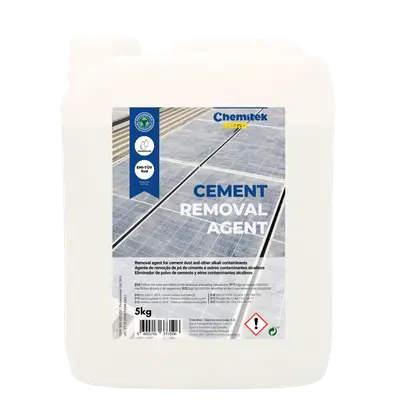
- RestoreInorganic Removal AgentDissolves cured cement dust, stone dust and gypsum that water can’t shift. 8 module-maker letters of conformity.
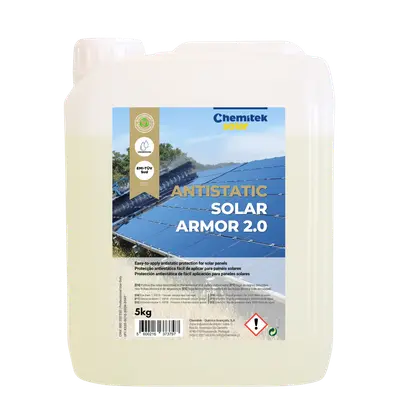
- ProtectAntistatic Solar Armor 2.0Anti-soiling coatings dosed into the wash water at 1 kg to 1,000 L. At least 12 months of protection (Chemitek).
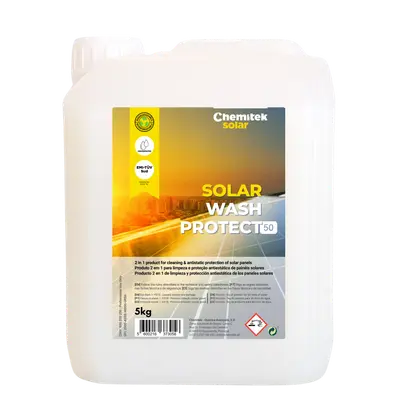
- Clean + protectSolar Wash ProtectConcentrated PV cleaner that leaves an antistatic, anti-adherent layer. 18 module-maker letters of conformity.
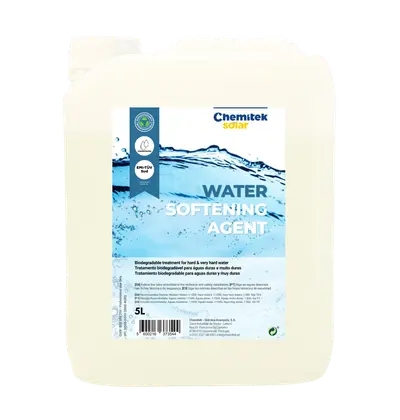
- PreventWater Softening AgentSoftens hard cleaning water in about 20 minutes, so rinses don’t leave scale.
Running your own crews? You can order just these products from us, with or without our engineers.


