
Why three phases?
Cleaning alone treats the symptom. If a contaminant has cured onto the glass, water won’t shift it. If nothing slows it bonding again, the plant soon needs the same hard clean. So the programme splits the work into three jobs, in order: restore the glass, protect it, then maintain it at the lowest cost.
Which phases a plant needs depends on whether you have soiling or contamination.
- Restore
Remove bonded soiling
- Typical product
- Inorganic Removal Agent, Lichen Removal Agent or Metal Oxides Removal Agent
- How we check it
- String current or inverter output against control strings
- Protect
Slow re-soiling
- Typical product
- Antistatic Solar Armor 2.0 or D-Solar Defendor
- How we check it
- Soiling rate before and after, on a soiling sensor
- Maintain
Keep output high at the lowest cost
- Typical product
- Solar Wash Protect in treated water
- How we check it
- Soiling ratio, water use and crew time per clean
Phase 1: Restore
Restore is a deep clean with the removal agent that matches the contaminant found in the soiling assessment:
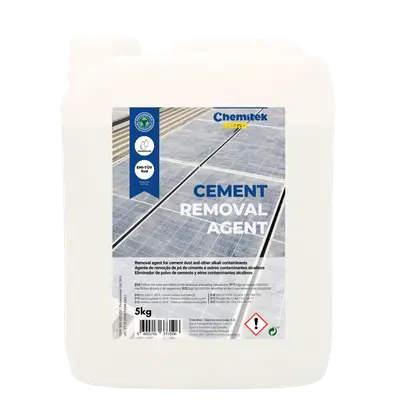
- Cured cement, stone dust, gypsum or hard-water stains: Inorganic Removal Agent. Chemitek’s datasheet starts at 1 kg in 2 L of water, strengthening to 1:1 or 1:0.5 if needed. It goes onto dry glass, is brushed in without adding water, then rinsed off thoroughly.
- Lichen, moss or fungi: Lichen Removal Agent at 1 kg in 10 L, left for 10–20 minutes, then brushed and rinsed.
- Rust and metal oxides: Metal Oxides Removal Agent, starting at 1:10 and strengthening to 1:5 if needed.
Where the source keeps producing dust, as beside a cement works, lighter follow-up treatments go into the calendar.

Phase 2: Protect
Protect coats the clean glass so new soiling sticks less:
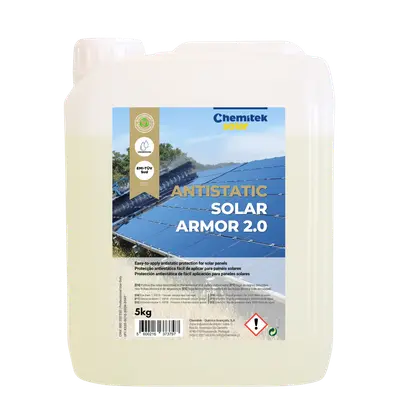
- Antistatic Solar Armor 2.0 is dosed at 1 kg per 1,000 L into the cleaning water of a rotary brush, robot or tractor, with no rinse. Chemitek states at least a year of protection, and up to 50% less water.
- D-Solar Defendor is a hydrophobic alternative, dosed at 1 kg per 1,000 L of soft water.
The first coat must go onto fully clean glass, which is why Restore comes first. Coatings are also site-specific. Long-term field averages show 20–50% less soiling, not the 80% or more of short tests (Ilse et al. 2019), and in a Northern Cape trial a hydrophobic coating increased dust soiling (du Plessis et al. 2020). The Morocco field trial compared three Chemitek products through a dry season. That is why we prove Protect in a pilot before it goes plant-wide.
Phase 3: Maintain
Maintain holds the plant at its restored output for the lowest cost:
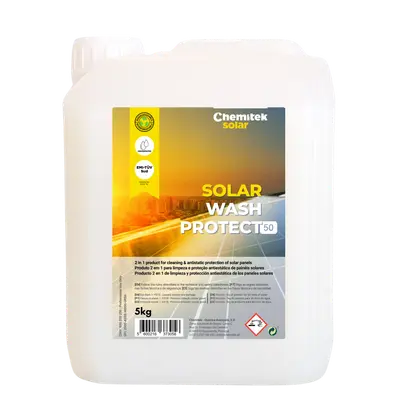
- Solar Wash Protect cleans and leaves an antistatic, anti-adherent layer that lasts about six months (Chemitek). SWP 50 is diluted 1 kg to 50 L and applied at about 150–200 mL/m².
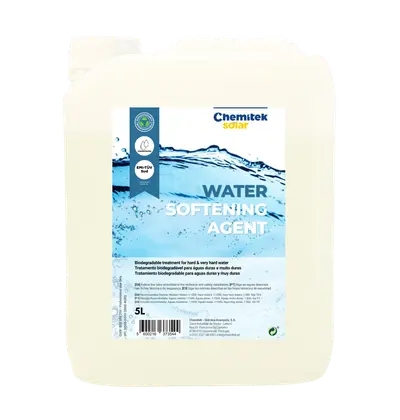
- Treated water. Where the water is hard, Water Softening Agent stops each rinse leaving scale.
- A calendar and a crew procedure, set from soiling data and cleaning economics, with a method statement your O&M crew can follow.
- Measurement. A soiling sensor shows when protection is wearing off and the next wash has earned its cost.
What the case studies show, phase by phase
Chemitek’s field cases follow the same order, and each phase has its own evidence:
| Phase | Case | What was measured or reported |
|---|---|---|
| Restore, then Protect | Chile: a 48 kWp carport beside a precast-concrete factory (Case study: Chemitek (Portugal), with Ecomundo) | Modules restored with Inorganic Removal Agent and coated with Antistatic Solar Armor pulled ahead of water-cleaned modules: the daily generation gap grew from 4.56% to about 11.9% between 1 October and 8 November 2022 |
| Restore, then Protect | Israel: a 160 kWp plant with cured cement (Case study: Chemitek (Portugal), with Girasol) | After Inorganic Removal Agent, 10 modules were coated with Antistatic Solar Armor by cleaning robot. Two weeks later they still cleaned fully, while cement had stuck to the uncoated modules |
| Protect | Vietnam: a 330 MW plant cleaned by robot (Case study: Chemitek (Portugal), with BIM AC Renewables) | D-Solar Defendor dosed into the robot’s water; coated strings produced more than water-cleaned strings in both the dry and the rainy season |
| Maintain | Malaysia: an 850 kWp hybrid station (Case study: Chemitek (Portugal), with TNBES) | Solar Wash Protect in high-TDS well water gained over the same water alone, which left a string worse off. The water matters as much as the product |
Our own North West pilot started with Restore too, and the programme we designed for that plant runs all three phases on a 24-month calendar.
Chemitek products for this
- RestoreInorganic Removal AgentDissolves cured cement dust, stone dust and gypsum that water can’t shift. 8 module-maker letters of conformity.
- ProtectAntistatic Solar Armor 2.0Anti-soiling coatings dosed into the wash water at 1 kg to 1,000 L. At least 12 months of protection (Chemitek).
- Clean + protectSolar Wash ProtectConcentrated PV cleaner that leaves an antistatic, anti-adherent layer. 18 module-maker letters of conformity.
- PreventWater Softening AgentSoftens hard cleaning water in about 20 minutes, so rinses don’t leave scale.
Running your own crews? You can order just these products from us, with or without our engineers.


